
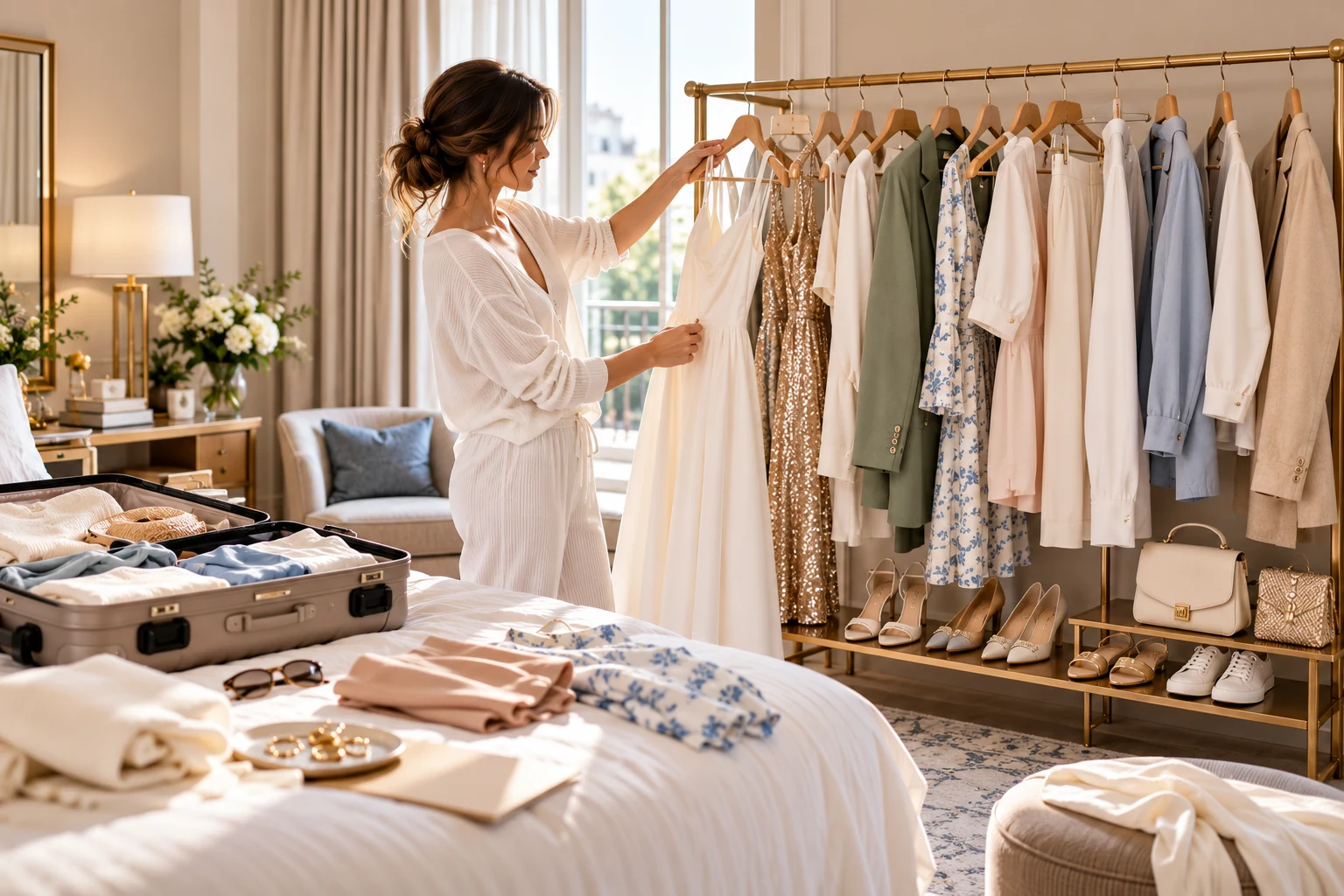
A wedding weekend can quietly turn into a surprising number of outfits.
There may be a welcome dinner, rehearsal, drinks with guests, the wedding morning, the ceremony and reception, an after-party, and a farewell brunch. Add travel days or a reception change, and it is easy to start treating every part of the weekend as an excuse—or obligation—to buy something new.
That can become expensive quickly. It can also leave you with a rail of highly specific white outfits, embellished shoes, novelty accessories, and occasion pieces that never make sense again once the wedding is over.
A better wedding weekend wardrobe does not require fewer memorable looks. It requires more deliberate ones.
The goal is to decide which moments genuinely deserve a special outfit, which can be built from clothes you already own, and which new pieces are worth buying because you would happily wear them again.
Start With the Actual Events, Not With an Outfit Shopping List
Before buying anything, write down every event where you realistically expect to change clothes.
A wedding weekend might include:
- travel or arrival;
- a welcome event;
- rehearsal dinner;
- casual drinks afterward;
- wedding morning;
- ceremony and reception;
- reception outfit change;
- after-party;
- farewell brunch;
- travel home.
You may not need a different look for every one of them.
For example, one outfit might work for both a rehearsal and the drinks that follow. Your brunch look could also be your travel-home outfit. A reception dress may work perfectly well at the after-party without another change.
Look at the schedule first. Then decide where a change actually adds something.
This prevents the wardrobe from being built around imagined moments that do not exist in the final itinerary.
Elegant digital invitations thoughtfully designed for a beautiful experience on every device.
Explore Templates
Decide Which Moments Matter Most to You
Not every event needs the same level of wardrobe attention.
Choose the one or two moments outside the wedding ceremony where clothing genuinely matters to you.
Maybe you have always imagined wearing a tailored white suit to the rehearsal dinner.
Maybe the welcome party has a strong theme and you want to participate fully.
Maybe you care much more about a fun reception change than anything you wear the day before.
Those priorities should receive most of your clothing budget and effort.
For the remaining events, aim for something polished, appropriate, and comfortable rather than trying to create another “bridal moment.”
That distinction can eliminate a great deal of unnecessary shopping.
You Do Not Have to Wear White All Weekend
One of the easiest ways to end up with clothes you never wear again is to assume that every wedding-related outfit must be white, ivory, or cream.
It does not.
If white feels special to you, use it where it has the most emotional value. But you can also wear:
- a favorite color;
- soft neutrals;
- prints;
- black;
- metallics;
- tailoring;
- seasonal colors;
- pieces that simply feel like your normal style at its most polished.
There is no requirement for a bride to be visually identifiable as “the bride” at every meal from Thursday through Sunday.
In fact, choosing colors and silhouettes you already wear can dramatically increase the chances that the clothing has a life after the wedding.
Build Around Your Existing Personal Style
Wedding-related shopping can encourage people to dress like a version of themselves they would never normally choose.
Someone who usually wears clean tailoring may suddenly buy a ruffled mini dress because it is marketed as “bridal.” Someone who lives in flats may buy several pairs of white heels. Someone who never wears satin may accumulate multiple satin slip dresses simply because they look wedding-adjacent.
Before shopping, look at your normal wardrobe.
Ask:
- Which silhouettes do I reach for repeatedly?
- Which necklines make me feel comfortable?
- Do I prefer trousers, dresses, skirts, or jumpsuits?
- Which shoes can I actually wear for several hours?
- Do I like fitted clothing or relaxed shapes?
- Which colors already dominate my wardrobe?
- What makes me feel dressed up without feeling disguised?
Your wedding weekend wardrobe should look like an elevated version of your existing style, not an entirely new character.
Choose a Simple Wardrobe Palette
A cohesive wardrobe is easier to build when the pieces relate to one another.
That does not mean everything needs to be the same color.
Choose a small palette that allows shoes, bags, jackets, jewelry, and other accessories to move between outfits.
For example, you might build around:
- ivory, black, and gold;
- cream, navy, and tan;
- white, soft blue, and silver;
- warm neutrals with one accent color.
This matters particularly when you have several events in a short period. If every outfit requires different shoes, a different bag, and a new layer, the number of purchases increases quickly.
A coordinated palette lets the same good accessories do more work.
Use Accessories to Make Familiar Clothes Feel Occasion-Specific
A piece does not need to be new to feel special.
A familiar dress can look completely different with:
- statement earrings;
- a silk scarf;
- a strong belt;
- an evening bag;
- a tailored blazer;
- a beautiful shoe;
- a hair accessory;
- different styling.
This is often a better place to add personality than buying another one-use outfit.
Accessories also tend to be easier to rewear after the wedding than highly specific bridal clothing.
If you want a subtle wedding reference, a pearl earring, ivory shoe, or metallic evening bag can create it without turning the entire look into wedding merchandise.
Make the Welcome Event Feel Like Your Real Style
A welcome party is often the first time many guests see you during the wedding weekend, which can make it feel like it needs a major outfit.
It can—but it does not have to.
Start with the actual setting.
For a garden welcome dinner, a relaxed dress or polished separates may be more appropriate than an elaborate mini dress.
For cocktails in a hotel bar, tailoring may feel more natural.
For a casual outdoor gathering, comfortable shoes and weather-appropriate layers matter more than formality.
If you are buying something new, the welcome event is a good place to choose a piece that works for future dinners, holidays, birthdays, or other occasions.
Avoid choosing solely because an item looks bridal in a product photograph.
Let the Rehearsal Dinner Have Its Own Identity
If your wedding includes a rehearsal dinner, you do not have to treat it as a preview of the wedding-day aesthetic.
It can be an opportunity to wear something different.
If the wedding gown is romantic, the rehearsal outfit might be sharply tailored.
If the ceremony look is minimal, the night before might be colorful or embellished.
If your main wedding look is formal, the rehearsal dinner can be relaxed.
Contrast makes each outfit more memorable and makes it easier to shop outside the narrow bridal category.
It also increases rewear potential because the piece does not need to imitate your wedding dress.
Be Practical About Wedding-Morning Clothing
Wedding-morning outfits are particularly vulnerable to one-use shopping.
Matching robes, personalized pajamas, feathered sets, embroidered shirts, and bridal slippers can be fun, but think honestly about whether you want them beyond the photographs.
You do not need highly themed clothing to look good while getting ready.
Useful options include:
- a button-down shirt you already own;
- a good pajama set you would genuinely sleep in later;
- a simple robe;
- relaxed trousers with a shirt;
- a slip dress that can be worn again;
- a comfortable matching set.
The most important practical consideration is often the neckline.
Choose something that can be removed without disturbing finished hair and makeup.
Beyond that, comfort matters more than whether the outfit announces that it is your wedding morning.
Treat a Reception Change as Optional
A second wedding-day outfit can be wonderful if you genuinely want one.
It can give you more freedom to dance, change the mood of the evening, or wear a completely different silhouette.
But it is not automatically necessary.
Before purchasing a reception look, ask what problem or desire it solves.
Are you changing because:
- the ceremony dress is difficult to dance in;
- you want to protect an elaborate gown;
- the evening has a different dress code;
- you have always wanted two distinct looks;
- you simply love the second outfit?
Those are all valid reasons.
But if the only reason is that reception changes seem expected, you may be buying an expensive outfit that gets worn for a very short time.
Also consider the timing. If dinner, speeches, photos, and first dances take most of the evening, a second dress may only appear for an hour or two.
Make sure that feels worthwhile to you.
If You Buy a Reception Outfit, Think Beyond “Bridal”
A reception change has excellent rewear potential if you resist overly specific bridal styling.
Consider pieces such as:
- a sleek evening dress;
- a tailored jumpsuit;
- a good suit;
- a metallic dress;
- a simple mini dress;
- a silk or satin slip dress in a color you love;
- separates that can later be worn independently.
The more dependent an outfit is on feathers, bridal slogans, oversized bows, novelty embroidery, or unmistakably wedding-specific details, the harder it may be to use again.
That may still be worth it if you love the look enough.
The point is to make that choice consciously rather than discovering afterward that the outfit has nowhere else to go.
Plan the After-Party Around Movement
An after-party outfit should work for what you will actually be doing.
If the night involves dancing, walking between venues, or staying out late, comfort becomes much more important.
Consider:
- breathable fabrics;
- secure shoes;
- a hemline you can move in;
- a bag that keeps your hands free;
- a layer if you will be outside;
- clothing that does not require constant adjustment.
In many cases, the reception-change outfit can continue into the after-party.
If you are comfortable and still like the look, there is no need to change again simply because the schedule has moved to another line.
Make the Farewell Brunch Easy
By the morning after the wedding, complicated clothing is rarely helpful.
A farewell brunch outfit should be something you can put on without extensive styling.
Good options might include:
- trousers and a knit;
- a casual dress;
- a shirt with jeans or tailored trousers;
- a skirt and simple top;
- a relaxed matching set.
This is one of the easiest events to build entirely from clothes you already own.
If you do buy something new, choose a piece that makes sense in your everyday or holiday wardrobe afterward.
The brunch is also a good place to move away from white if you have been wearing it throughout the weekend.
Shop Your Closet Before Shopping Online
Once you know the schedule, physically try on potential outfits from your existing wardrobe.
Do not rely on memory.
You may discover that you already own:
- the perfect welcome-event dress;
- trousers that work with a new top;
- a blazer that transforms a simple outfit;
- shoes suitable for several events;
- a bag that coordinates with almost everything;
- a comfortable brunch look.
Try complete outfits, including shoes and accessories.
Photograph them.
Then identify genuine gaps.
This turns shopping into a targeted exercise instead of browsing until something feels “wedding enough.”
Buy Missing Pieces That Solve More Than One Problem
When you identify gaps, prioritize items that can work more than once.
A blazer might work at both the rehearsal dinner and farewell brunch.
A pair of metallic sandals could work with three different outfits.
A small evening bag may cover the welcome dinner, rehearsal dinner, reception, and future events.
A silk blouse might be worn during the wedding weekend and later with jeans or work trousers.
The strongest purchase is often not the most dramatic piece. It is the one that makes several outfits work.

Use the “Three Future Wears” Test
For any new piece that is not your wedding gown, ask yourself whether you can imagine at least three realistic occasions where you might wear it again.
Not vague possibilities—actual situations.
For example:
- a restaurant anniversary dinner;
- a holiday;
- a friend’s wedding;
- a birthday;
- a work event;
- a summer party;
- a date night;
- another formal celebration.
If you cannot think of any, decide whether the wedding use alone is worth the cost.
Sometimes it absolutely is.
A special piece does not need to be practical if it gives you enough joy.
But the test helps separate a deliberate special purchase from an impulse purchase disguised as wedding preparation.
Consider Whether a White Piece Can Be Restyled Later
If you genuinely want several white or ivory looks, choose pieces that can lose their “bridal” identity after the wedding.
A white suit can later be worn as separate trousers and jacket.
A simple ivory slip dress may work with a leather jacket or colored accessories.
A white shirt can return immediately to an everyday wardrobe.
A plain mini dress may be altered, shortened, dyed where appropriate for the fabric, or styled very differently.
The more neutral the construction, the easier it is to change the context later.
Rent Where Ownership Does Not Add Value
Some wedding-weekend looks are perfect candidates for rental.
Rental can make sense when:
- you want a dramatic designer piece for one evening;
- you want something highly trend-driven;
- you know you are unlikely to rewear it;
- storage matters;
- the purchase price feels difficult to justify.
It can be especially useful for statement accessories, evening dresses, or fashion-forward welcome-event looks.
Before renting, check practical details such as delivery timing, backup options, return deadlines, condition expectations, and whether alterations are permitted.
The point is not that renting is always cheaper or better. It is that ownership is not automatically necessary.
Borrowing Can Make an Outfit More Meaningful
A borrowed piece can add personality without adding another purchase.
Consider borrowing:
- jewelry;
- a bag;
- a jacket;
- a scarf;
- a hair accessory;
- a family piece;
- formal outerwear.
This can be particularly meaningful when the item belongs to someone important to you.
Borrowing also works well when you need something unusually formal for only one event.
Choose Shoes Based on the Weekend You Actually Have
Multiple wedding events can easily lead to buying several pairs of shoes that are only slightly different from one another.
Instead, choose a small footwear plan.
You might need:
- one polished heel or formal shoe;
- one comfortable dressier flat or lower shoe;
- one casual option.
Think about surfaces as well as aesthetics.
Grass, cobblestones, stairs, sand, long hotel corridors, and hours of standing all affect what will actually work.
A pair you can use for several events is generally more valuable than an outfit-specific shoe that matches perfectly once.
Outerwear Should Not Be an Afterthought
Wedding wardrobes are often planned as though temperature never changes.
If any event is outdoors or involves walking between locations, include layers in the plan.
Depending on the season, that might mean:
- a blazer;
- wrap;
- cardigan;
- coat;
- leather jacket;
- light trench.
Ideally, the layer should work with more than one outfit.
Buying emergency outerwear just before the wedding is often where unnecessary pieces enter the wardrobe.
Consider the Practical Side of Light Colors
If you plan to wear white, ivory, or very pale colors through several events, think about how those clothes will be used.
Food, makeup, drinks, travel, outdoor seating, and crowded parties all increase the chance of marks.
Ask yourself whether the item is:
- easy to clean;
- washable;
- dry-clean only;
- delicate around food or drinks;
- difficult to travel with.
A piece you are afraid to sit down in is not necessarily a useful wedding-weekend outfit.
Avoid Overbuying Too Early
Your wardrobe plan may change as the wedding becomes more defined.
Venues change. Dress codes change. Weather forecasts become clearer. Events get added or removed. A welcome dinner becomes drinks. A formal brunch becomes a casual coffee.
Buying every outfit many months in advance can leave you solving problems that no longer exist.
Once the major events are confirmed, build the wardrobe gradually.
Prioritize pieces with longer lead times or alterations first. Leave simple, flexible items until later if necessary.
Keep the Wardrobe Cohesive Without Making It a Costume
A cohesive wedding weekend wardrobe does not mean wearing the same aesthetic repeatedly.
You do not need three white mini dresses that differ only slightly.
Cohesion can come from smaller recurring elements:
- similar jewelry;
- a consistent color palette;
- the same bag;
- repeated metallic accents;
- related silhouettes;
- a recognizable styling approach.
That gives the weekend visual continuity without making every outfit feel like part of a uniform.
Pack by Complete Look
When the wedding weekend arrives, pack each outfit as a complete unit rather than as separate categories of clothing.
For each event, confirm:
- clothing;
- underwear;
- shoes;
- jewelry;
- bag;
- outer layer;
- hair accessory if needed.
Photographs of each finished look can be surprisingly useful.
This prevents last-minute situations where the dress is packed but the correct bra is at home, or the shoes only work with a bag you forgot.
It also helps you spot unnecessary duplication before packing.
Leave Some Flexibility
Not every clothing decision needs to be fixed months in advance.
Weather, energy, timing, and event plans can all change.
If two outfits could work for a casual welcome event, bring both only if they already belong to your wardrobe and packing space allows it. Do not buy multiple backup looks for every possible scenario.
A flexible wardrobe is built from compatible pieces, not from owning twice as many outfits.
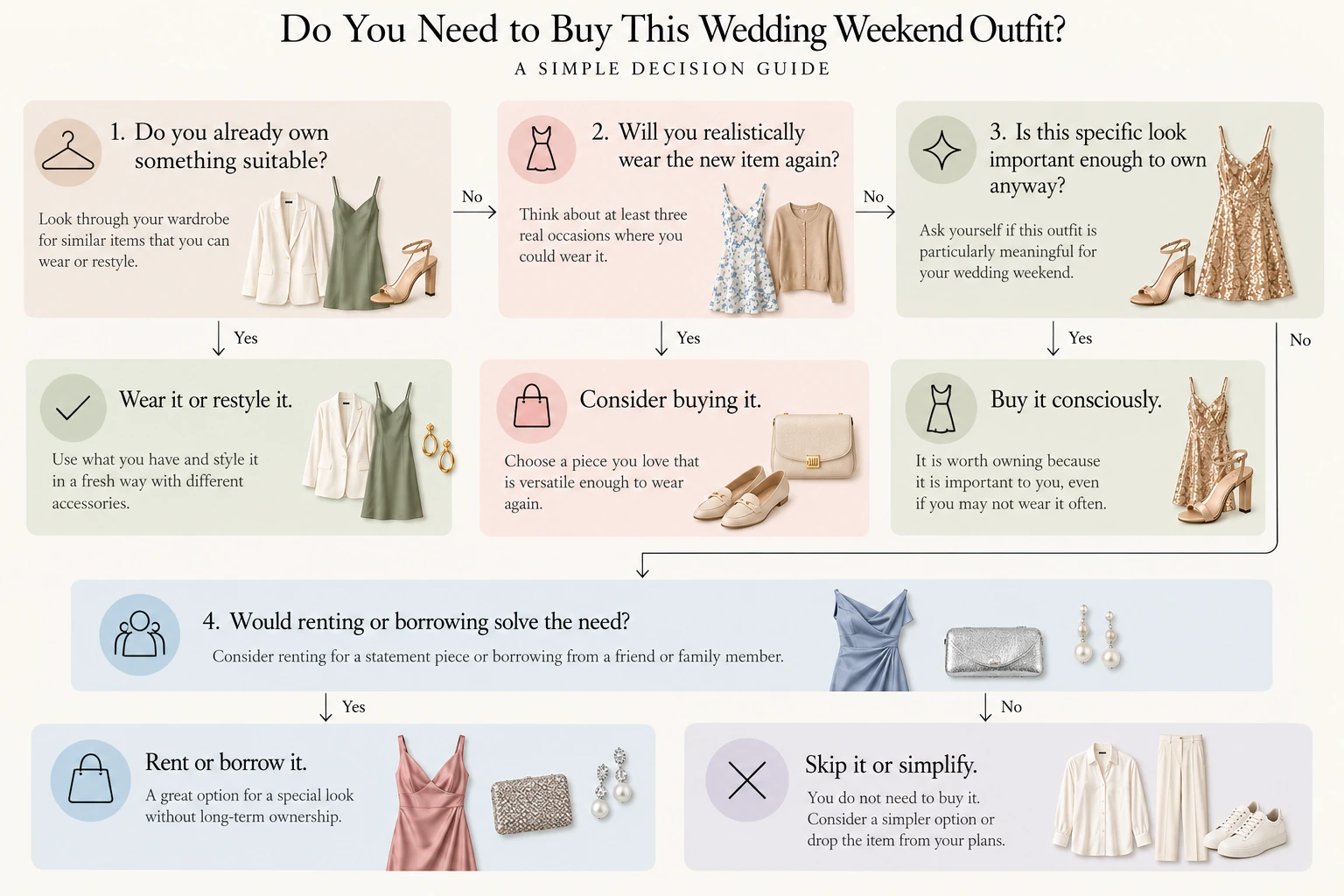
What Is Actually Worth Buying New?
There is no universal answer, but a useful priority order is:
Buy new when the piece is important to you and hard to replace.
This may include a reception outfit you genuinely love or a tailored look you know you will rewear.
Use what you own when the event does not need a special fashion moment.
Brunch, travel, casual drinks, and getting-ready time are often easy places to do this.
Rent or borrow when you want impact without long-term ownership.
This can work well for statement pieces and highly specific accessories.
Skip the item entirely when it only exists because wedding marketing says you should have it.
That last category can save more money—and wardrobe space—than any shopping strategy.
A Wedding Weekend Wardrobe Should Still Belong to Your Real Life
It is reasonable to want wedding-related events to feel special.
Clothing can be part of that. A welcome-night outfit, reception change, or beautifully chosen accessory can become part of how you remember the weekend.
The problem is not buying something new.
The problem is buying without deciding why.
Start with the actual events. Choose the moments where fashion matters most to you. Build around your existing style. Reuse accessories. Shop your own wardrobe before filling gaps. When you do buy, choose pieces that either have a believable life afterward or are special enough that you are comfortable with them being wedding-specific.
A good wedding weekend wardrobe should feel cohesive in photographs.
A better one should also make sense when the wedding is over.