
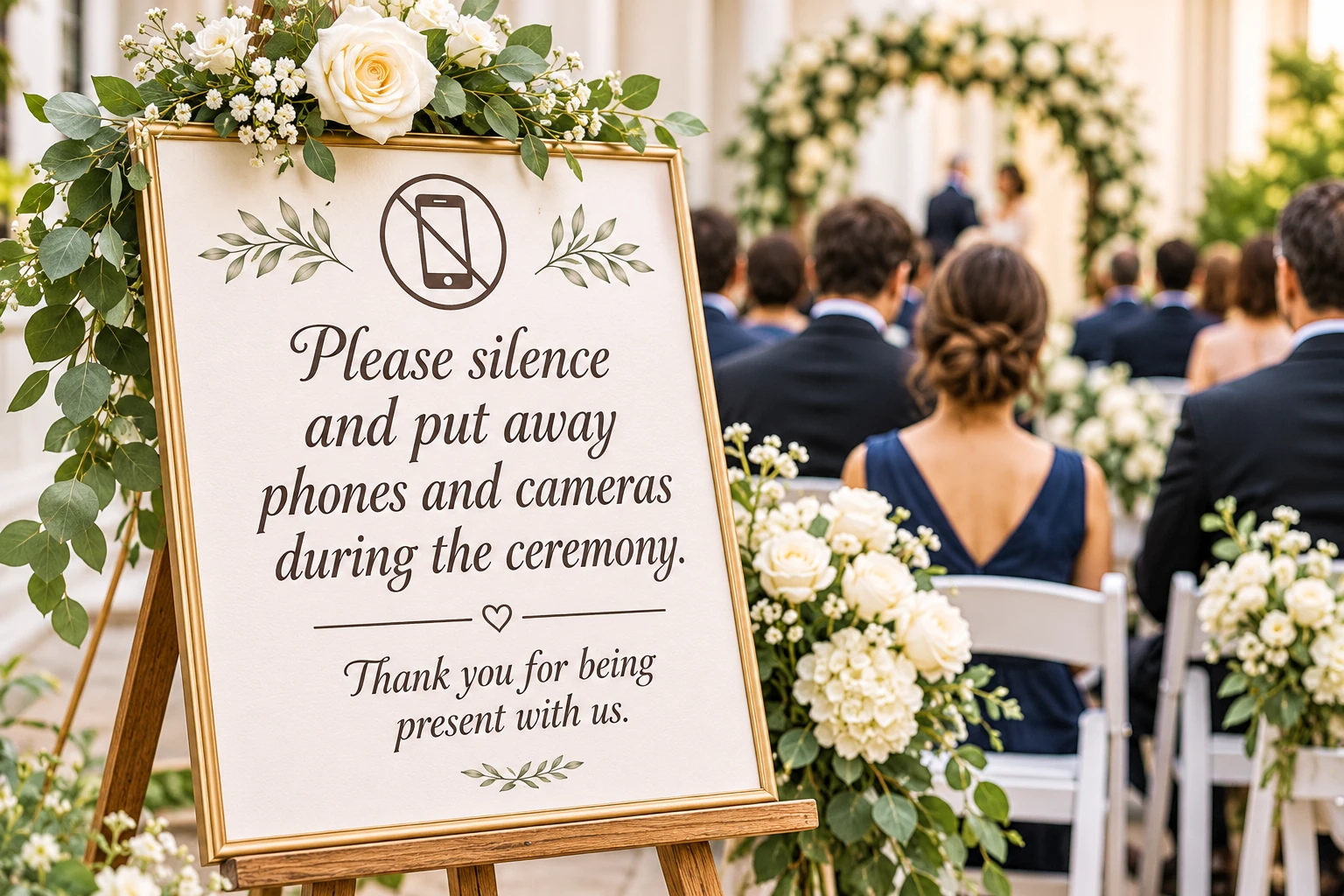
An unplugged ceremony sounds simple until you have to tell a room full of people what it actually means.
You may want guests to put their phones away.
You may want no personal photography during the processional.
You may want everyone to stay off social media until you have shared your own photos.
Or you may simply want the ceremony to feel like a moment people are participating in rather than documenting.
Those are different requests.
The etiquette challenge is not whether couples are allowed to make them. It is how to communicate the boundary clearly enough that guests know what to do without making the invitation feel like a list of rules.
The best unplugged-ceremony wording is usually short, specific, and warm.
It tells guests what you are asking.
It gives them a simple reason when useful.
And then it moves on.
First decide what “unplugged” means for your wedding
Before writing a sign or adding a sentence to the wedding website, define the actual boundary.
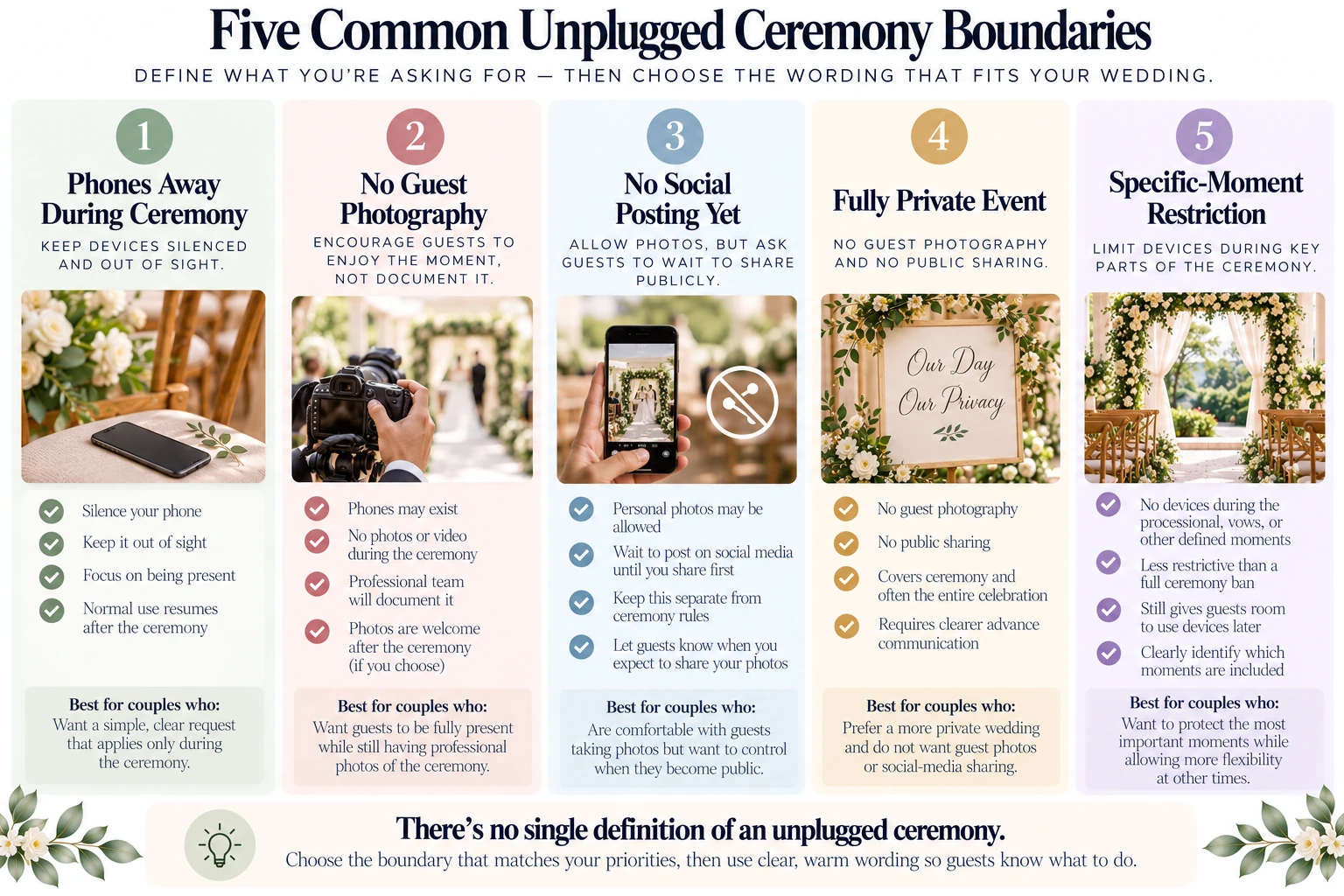
“Unplugged ceremony” can mean several things:
- no phones at all;
- phones allowed but kept on silent and out of sight;
- no guest photography;
- no cameras or phones during the ceremony, but photos are welcome afterward;
- no social-media posting until the couple shares first;
- no devices during only certain moments, such as the processional and vows.
If you have not decided which version you mean, guests cannot be expected to interpret it correctly.
A sign that simply says “Welcome to our unplugged wedding” may sound elegant, but it leaves practical questions unanswered.
Can someone take a photo before the ceremony begins?
Can parents photograph the recessional?
Does “unplugged” mean no social posting or no devices?
Does the request continue into cocktail hour?
Clear etiquette starts with a clear request.
Elegant digital invitations thoughtfully designed for a beautiful experience on every device.
Explore Templates
Ceremony-only rules are often easier for guests to understand
For many couples, the most practical boundary is:
Please keep phones and cameras away during the ceremony. Afterward, photos are welcome.
This gives the request a defined beginning and end.
Guests know they are not being asked to avoid their phones for the entire wedding.
They also know there will be a point when taking personal photos becomes acceptable again.
That distinction can make the request feel less restrictive while still protecting the part of the day you care most about.
If your boundary extends beyond the ceremony, say so directly.
Do not use “unplugged ceremony” when what you really mean is “please do not post any wedding photos online until tomorrow.”
Those are different etiquette issues and should be communicated separately.
Make the wording a request, not a reprimand
Most guests are not planning to disrupt your ceremony.
Treating everyone as though they are likely to misbehave can make an otherwise reasonable request sound unnecessarily hostile.
Compare:
Please silence and put away all phones and cameras during the ceremony. We would love to have you fully present with us.
with:
ABSOLUTELY NO PHONES. DO NOT RUIN OUR PHOTOGRAPHER’S SHOTS.
Both technically communicate a boundary.
Only one communicates it graciously.
You do not need to apologize for asking.
But you also do not need to anticipate conflict in the wording.
A good rule is to write for the cooperative guest.
The request should still be clear enough for the person who might otherwise take out a phone, but the tone does not need to punish everyone else in advance.
Avoid wording that shames guests for wanting photos
Guests often take pictures because they are excited.
They want to remember the moment.
They want to share it with family.
They may think they are helping by capturing an angle you will enjoy later.
That does not mean you have to allow personal photography during the ceremony.
It does mean the wording can recognize the positive intention without accepting the behavior.
For example:
We are grateful that you want to capture the day with us. During the ceremony, however, we ask that phones and cameras remain tucked away so everyone can be fully present.
That is more generous than implying that guests who reach for a phone are selfish or disrespectful.
The boundary stays exactly the same.
Only the tone changes.
You do not need a long explanation
Couples sometimes over-explain an unplugged ceremony because they are worried the request will sound rude.
The result can be a paragraph defending the decision.
You do not need one.
Most guests only need three things:
- what you want them to do;
- when the rule applies;
- when normal phone or camera use can resume, if relevant.
For example:
We kindly ask that phones and cameras remain away during the ceremony. Once we are officially married, please feel free to take all the photos you like.
That is enough.
If your reason genuinely helps—such as wanting guests to be present—you can add one short sentence.
But the request becomes weaker, not stronger, when it turns into an essay.
“Be present with us” works best when it is paired with a concrete instruction
Phrases such as:
Be fully present.
Be here with us.
Enjoy the moment.
can sound beautiful on a sign.
They are also ambiguous.
A guest may feel fully present while taking a photograph.
If the real request is no photography, say that.
The emotional message can come second:
Please keep phones and cameras away throughout the ceremony and be fully present with us as we exchange our vows.
Now the guest knows both the behavior and the reason.
Tell guests before they sit down if the rule matters to you
A small sign at the back of the ceremony can help, but it should not necessarily carry the entire communication burden.
Guests may not see it.
They may walk past while greeting relatives.
They may assume it is decorative.
If an unplugged ceremony is important to you, consider communicating it through more than one gentle touchpoint.
Possible places include:
- the wedding website;
- a ceremony-details page;
- a small card or note if it naturally belongs in the invitation suite;
- a sign at the ceremony entrance;
- the printed program;
- a short announcement before the processional.
You do not need to use all of them.
The objective is not repetition for its own sake.
The objective is to make sure the expectation reaches guests before the moment when they need to follow it.
The invitation itself does not always need to carry the request
The formal invitation has a specific job: inviting the guest and giving the essential event details.
An unplugged-ceremony instruction can sometimes feel out of place on the main invitation, especially if it requires explanation.
A wedding website, details card, program, or ceremony sign may provide more natural space.
That does not mean the request is unimportant.
It means communication is often more effective when information appears where guests need it.
If the invitation suite already contains a details card with ceremony notes, the request may fit there easily.
If the wedding website has a short “What to Know” section, that may be even simpler.
A ceremony sign should be readable before it is decorative
An unplugged-ceremony sign often appears in wedding inspiration because it can be styled beautifully.
But the sign has a practical function.
Guests need to read it.
Avoid long poems in tiny script.
Avoid placing the crucial instruction in low-contrast lettering.
Avoid making “unplugged ceremony” the largest phrase if some guests may not know what the term means.
A useful sign might say:
Welcome. We kindly ask you to silence and put away phones and cameras for the ceremony. Thank you for being present with us.
The decorative treatment can reflect your wedding.
The instruction should remain unmistakable.
An announcement can be more effective than a sign alone
If it really matters that nobody raises a phone during the ceremony, a brief spoken announcement before the processional can remove uncertainty.
This can come from:
- the officiant;
- a ceremony host;
- a coordinator;
- another appropriate person who already has a speaking role.
The announcement does not need to be stern.
For example:
Before we begin, the couple asks that you please silence and put away all phones and cameras for the ceremony. They are so happy to have you here and would love to share this moment with you fully present.
Then begin.
There is usually no need for a lecture.
The closer the reminder occurs to the ceremony, the easier it is for guests to act on it.

Decide whether professional cameras are an obvious exception
If you have hired photographers or videographers, guests will naturally see people using cameras after being told not to do so.
Most will understand the difference.
Still, the wording can prevent confusion:
Our photography team will capture the ceremony, so we invite you to relax and enjoy it with us.
This can also reassure guests who are reaching for phones because they are worried important moments will otherwise go undocumented.
But avoid turning the photographer into a threat.
Do not block the photographer can sound accusatory.
Our photographers have the moments covered conveys the same practical idea more graciously.
Do not promise professional photos to every guest unless you mean it
A common sentence is:
We promise to share the professional photos with you.
Only use that if you actually expect to make them broadly available.
You may ultimately receive hundreds or thousands of images and share only a selection publicly.
There is no need to create an unnecessary promise just to justify the unplugged request.
You can simply say:
Our photographers will capture the ceremony.
That is enough.
Think carefully before making exceptions
You may have a parent, grandparent, or close relative who strongly wants to take a photograph.
You are free to make an exception.
But invisible exceptions can create confusion.
If one guest has a phone raised in the front row, others may reasonably assume the rule has ended or does not apply equally.
If an exception matters to you, consider whether it can happen before the ceremony, during a designated moment, or from a position that does not invite everyone else to follow.
The goal is not rigid enforcement.
It is avoiding mixed signals.
Accessibility and genuine needs matter
“Put every phone away” sounds straightforward until someone is using a device for something other than photography.
A guest may rely on a phone for:
- translation;
- hearing or accessibility support;
- health monitoring;
- communication with a caregiver;
- emergency contact;
- another legitimate need that is not obvious to people around them.
An unplugged request should target the behavior you care about, not the mere existence of a device.
If your concern is photography, say no photography.
If your concern is devices being visible during the ceremony, make the general request without turning it into aggressive enforcement.
There is rarely any need to have someone policing guests’ screens.
Parents may need a little flexibility
Some guests may need to remain reachable because children are with a sitter.
That does not mean they need to scroll through messages during your vows.
A polite request can leave room for common sense:
Please silence your phone and keep it away during the ceremony. If you need to take an urgent call, we completely understand—please step outside quietly.
You do not necessarily need this language on the sign.
But it is a sensible principle for the way the rule is handled.
Courtesy works in both directions.
Be especially clear about social-media restrictions
An unplugged ceremony and a social-media embargo are not the same thing.
A guest can obey the ceremony rule perfectly, take photographs during cocktail hour, and post them immediately.
If you do not want photos shared publicly before you have posted your own, communicate that as a separate request.
For example:
We are happy for you to take photos after the ceremony. We only ask that you wait to share them publicly until we have posted our first photos.
If privacy is especially important, be more explicit.
Do not assume “unplugged” automatically communicates “no posting.”
If you want no photography anywhere, say that directly
Some weddings are intentionally private.
The couple may not want photographs taken by guests during the ceremony or reception.
That is a much broader request than a standard unplugged ceremony and should be presented as such.
For example:
We kindly ask guests not to take or share photographs during today’s celebration. Thank you for helping us keep the day private.
This boundary may require more advance communication because it differs from what many guests expect at a wedding.
It is better for them to know before they arrive than to discover the rule only after taking out a camera.
Avoid asking vendors or family members to become phone police
A ceremony does not become more graceful because someone is walking the aisle telling people to put their phones away.
Most guests will comply with a clear request.
For the small number who do not, decide in advance how much it really matters.
If someone quietly takes one photo from their seat, interrupting the ceremony to enforce the rule may create a larger disruption than the photo itself.
If a person is standing in the aisle, blocking the processional, using a flash repeatedly, or obviously interfering with the ceremony, a coordinator or appropriate venue team member may be able to intervene discreetly.
But an unplugged ceremony should not feel like entering a restricted facility.
Communication should do most of the work.
Do not make your officiant improvise the request
If you want an announcement, provide the wording in advance.
Otherwise an officiant may say something much stricter, much softer, or much longer than you intended.
Include it in the ceremony notes.
A simple script might be:
Before the ceremony begins, please remind guests to silence and put away phones and cameras until the ceremony has ended. Keep the tone warm and brief.
Then provide the actual wording if you have a preference.
This is a small planning detail that can prevent an awkward surprise.
Match the wording to your wedding’s voice
A formal ceremony may call for:
The couple respectfully requests that all phones and cameras remain silenced and put away throughout the ceremony.
A relaxed celebration might use:
We love that you want to capture the moment, but for the ceremony we’d love to see your faces instead of your phones. Please tuck devices away until we’re officially married.
A very minimal sign could say:
Phones down. Hearts open. Please no photos during the ceremony.
Tone can vary.
Clarity should not.
The cleverest line is not necessarily the best line if guests cannot tell what it asks them to do.
Humor can work—but not if it weakens the instruction
An unplugged sign is sometimes written as a joke.
That can fit the wedding.
But humor has a problem: guests may read it as optional.
If the request genuinely matters to you, keep the actual instruction unmistakable.
For example:
Good news: no one needs to work today. Our photographers have it covered. Please put away phones and cameras for the ceremony and enjoy the moment with us.
The humor supports the instruction.
It does not replace it.
Use positive wording without becoming vague
There is often a false choice between being polite and being direct.
You can do both.
Good phrases include:
- We kindly ask…
- Please keep…
- We invite you to…
- During the ceremony, please…
- Once the ceremony has ended, you are welcome to…
Less useful phrases are those that soften the request until nobody knows whether it is really a request:
- If you don’t mind…
- We’d sort of prefer…
- Maybe consider keeping your phone away…
You are hosting the event.
You can establish a reasonable ceremony boundary.
Courtesy does not require uncertainty.
Give guests a clear moment when the restriction ends
If photographs are welcome after the ceremony, say so.
This is one of the easiest ways to make an unplugged request feel balanced.
For example:
Please keep phones and cameras away during the ceremony. After the recessional, we would love for you to capture and share the celebration.
Now guests know they are not being asked to suppress their enthusiasm for the entire day.
They simply know when to wait.
If your rule ends after cocktail hour, after portraits, or after you make a first social post, identify that boundary instead.
What if someone ignores the request?
It may happen.
A guest may forget.
Someone may believe the rule does not apply to them.
Someone may take a quick photo without realizing how visible the phone is.
Decide before the wedding whether that possibility deserves emotional energy.
You can communicate the request clearly.
You can reinforce it politely.
You cannot control every person’s behavior without turning the ceremony into an enforcement exercise.
For many couples, the best approach is to prevent the most disruptive behavior and then let minor imperfections go.
A phone appearing in one photograph does not have to define the ceremony.
What if family members object?
Some relatives may feel strongly about taking their own pictures.
If you expect resistance, communicate with them personally before the wedding rather than arguing at the ceremony entrance.
Explain the boundary simply.
You might say:
We know photos are important to you. We are asking everyone to keep cameras and phones away only during the ceremony. Our photographer will be documenting it, and as soon as the ceremony ends you are absolutely welcome to take your own pictures.
Do not turn the conversation into a debate about whether unplugged ceremonies are right in general.
You are simply explaining how this ceremony will work.
A few wording options for different situations
For a straightforward ceremony-only request:
Please silence and put away phones and cameras during the ceremony. Afterward, you are warmly invited to take photos and enjoy the celebration.
For a presence-focused request:
We would love to see your faces as we exchange our vows. Please keep phones and cameras tucked away throughout the ceremony and be fully present with us.
For a photographer-focused explanation:
Our photography team has the ceremony covered. Please relax, keep devices away, and experience the moment with us.
For a more formal tone:
The couple respectfully requests an unplugged ceremony. Please silence and put away all phones and cameras until the ceremony has concluded.
For a social-media boundary:
Photos are welcome after the ceremony. We only ask that you wait to post publicly until the couple has shared their first images.
For privacy throughout the event:
To protect the privacy of everyone celebrating with us, we kindly ask guests not to take or share photographs during the wedding. Thank you for respecting our wishes.
The right version is the one that accurately describes your actual boundary.
The most polite wording is the wording guests can understand
Etiquette is not about making the request so soft that it disappears.
It is about respecting guests while communicating a reasonable expectation.
An unplugged ceremony works best when the message is:
specific enough that people know what behavior is requested;
brief enough that it does not sound defensive;
warm enough that guests do not feel accused;
and repeated only where repetition genuinely improves clarity.
Decide what “unplugged” means.
Tell guests before the ceremony if the rule matters.
Use a readable sign or short announcement if needed.
Allow for legitimate device use.
Separate photography rules from social-media rules.
And give guests a clear point when they can start taking pictures again.
You do not need to sound strict to be understood.
You simply need to make the boundary clear.