
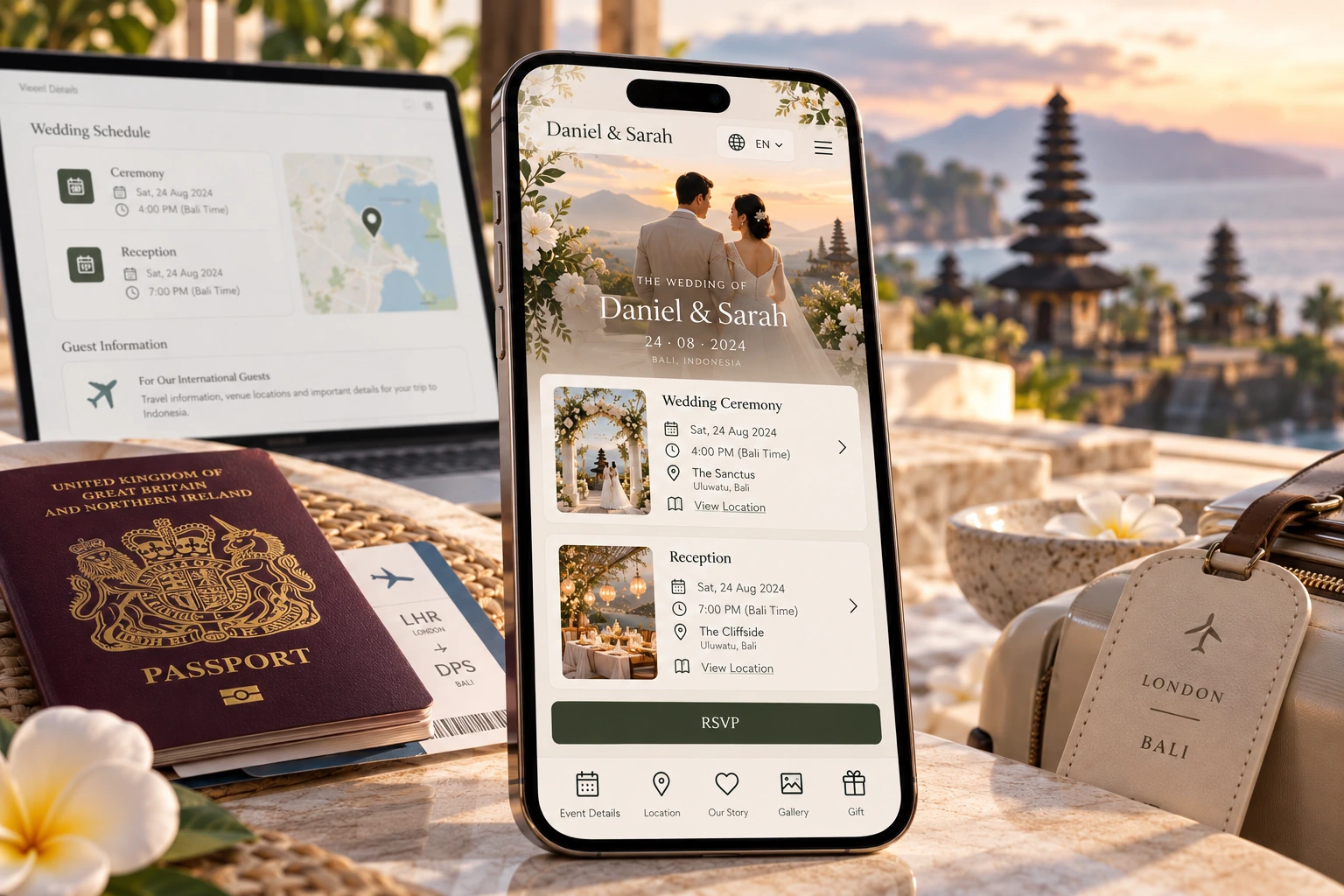
When some of your wedding guests are travelling from the UK to Indonesia, an invitation has to do more than announce a date.
For a local guest who already knows the area, a venue name and start time may be enough. An international guest may be reading the same invitation months earlier while trying to understand which events they are invited to, what time each part begins, where the venues are, whether they need to respond for one or several people, and which information they should save for the trip.
That makes clarity more important than adding more decorative content.
Verlieb’s invitation builder is useful in this context because event information, maps, RSVP, languages and other sections are handled as structured parts of the invitation rather than being compressed into a single block of wording. The current builder can store multiple event records, invitation-level timezone information, venue and address details, map links, guest responses and translated invitation content.
The challenge for the couple is deciding how to use those tools so that an invitation remains easy to understand from another country.
First, decide exactly which events each guest needs to understand

International weddings often become confusing when the invitation treats the celebration as though it were one event even when guests actually need to keep track of several.
A wedding in Indonesia might involve a ceremony and reception at different times, separate family events, or another scheduled gathering relevant to particular guests. The invitation does not need to explain every part of the wedding to everybody, but anything a guest is expected to attend should be unmistakable.
Verlieb’s Event Details structure can hold individual events with information such as:
- an event name;
- date;
- start and end time;
- venue;
- full address;
- map link;
- additional notes.
The exact fields and number of events available can depend on the selected template’s event contract, so this is something to check while choosing the template rather than after all the invitation content has been prepared.
For an international guest, each event should answer three questions immediately:
What is this event?
Avoid making the guest infer whether an entry refers to the ceremony, reception or another gathering.
When does it happen?
Give a precise date and time.
Where do I need to go?
Include both a useful venue description and a location link where appropriate.
When several events are shown separately, the guest can understand the wedding schedule without piecing it together from paragraphs of prose.
Elegant digital invitations thoughtfully designed for a beautiful experience on every device.
Explore Templates
Make the wedding’s local time unambiguous
Time is one of the easiest details to misunderstand when hosts and guests are in different countries.
Verlieb’s current builder uses an invitation-level timezone rather than treating the event time as an isolated number. The timezone can be configured using recognised timezone identifiers, and event dates and times are then handled against that invitation setting.
That is useful technically, but couples should still write the invitation for a human reader.
Do not assume an overseas guest will automatically know whether “4:00 PM” refers to their own local time or the wedding destination.
For a wedding taking place in Indonesia, treat the event time as the local time at the wedding location and make that context clear somewhere appropriate in the invitation. If there are guests joining planning conversations from the UK, be especially careful not to copy times from calendars or messages that have already been converted into another timezone.
The same principle applies to RSVP deadlines.
If the response closes on a particular date and time, guests should be able to tell what deadline the invitation is using. Verlieb can associate RSVP timing with the invitation’s timezone, but clear wording is still better than expecting guests to understand the technical behaviour behind the page.
What the builder does not justify is promising that every guest will automatically see every event converted into their own device’s local time. The safer editorial approach is to communicate the wedding’s destination time clearly.
Use venue information for someone who has never been there
Local guests often recognise a hotel, church, restaurant or wedding venue from its name alone.
An international guest may not.
Verlieb’s event structure allows a venue name, full address and external map URL to be stored separately. This makes it possible to present the venue as both understandable information and a practical destination link.
For overseas guests, use those fields deliberately.
The venue name gives context. The full address helps confirm that the correct location has been found. The map link provides a direct route into a mapping service from the guest’s phone.
Before publishing, open every map link yourself on a mobile device. Check that it lands on the correct property rather than simply on the right district, road or similarly named venue.
If different events take place at different locations, check every event separately.
A link is more useful than a long written explanation, but it does not turn Verlieb into a transport or travel-planning service. The invitation can communicate where an event takes place; transport arrangements, airport transfers or accommodation bookings still need to be handled separately if your wedding requires them.
Give international guests enough context without turning the invitation into a travel guide
An international invitation can easily become overloaded.
Couples often realise that overseas guests have more questions and respond by adding everything they know: flight advice, hotel lists, transport possibilities, destination notes, packing reminders and wedding information all on one page.
More information is not always more helpful.
The invitation’s primary role should remain clear:
- what the guest is invited to;
- when it takes place;
- where it takes place;
- what response is required;
- any essential wedding-specific instruction.
If there is additional travel information that genuinely needs to be shared, keep it clearly separated from the event essentials rather than mixing it into the ceremony or reception description.
Verlieb’s section-based builder makes this easier because the invitation does not need to behave like one uninterrupted piece of text. You can keep the essential event information structured while using other suitable sections for supporting content.
The test is whether a guest standing in an airport or hotel lobby can reopen the invitation and find the event they need without rereading your entire wedding story.
Decide what the RSVP must collect from overseas guests
For international guests, RSVP is not simply an attendance count.
You may need to know whether someone is coming at all before making further plans around seating, meals or guest logistics.
Verlieb’s current RSVP flow can collect the guest’s name, an attending or not-attending response and, for attending responses, the number of guests covered by that reply. Couples can also configure phone collection, meal preferences, an RSVP deadline and a message field.
That gives you flexibility, but it does not mean every available question should be switched on.
Start with the decisions you genuinely need from the guest.
If one invitation is addressed to a household or couple, decide how many attendees one response is allowed to cover.
If caterers need meal choices, configure the options in language that guests will understand.
If a phone number is genuinely useful for wedding communication, decide whether it should be optional or required. In the audited Verlieb RSVP flow, the phone field is treated as information for the invitation owner rather than something displayed publicly.
And set a deadline that gives international guests enough time to make a realistic attendance decision.
The detailed quality of the RSVP and Guestbook experience belongs to a separate Verlieb evaluation, but for international invitation planning the important principle is simple: ask only for information that will lead to a planning decision.
Do not hide important guest instructions inside RSVP
An RSVP form is useful for collecting answers. It should not carry the burden of explaining the wedding.
For example, if a guest needs to know that the ceremony and reception are at different venues, that information belongs in the event details.
If there is an essential arrival instruction, it should be visible before the guest is asked to respond.
If a meal-selection question needs explanation, make the available options understandable rather than relying on a free-text guest message.
International guests already have more information to process. The invitation should progressively answer their questions rather than reveal important information only when they reach a form.
Choose the primary invitation language from the guest list
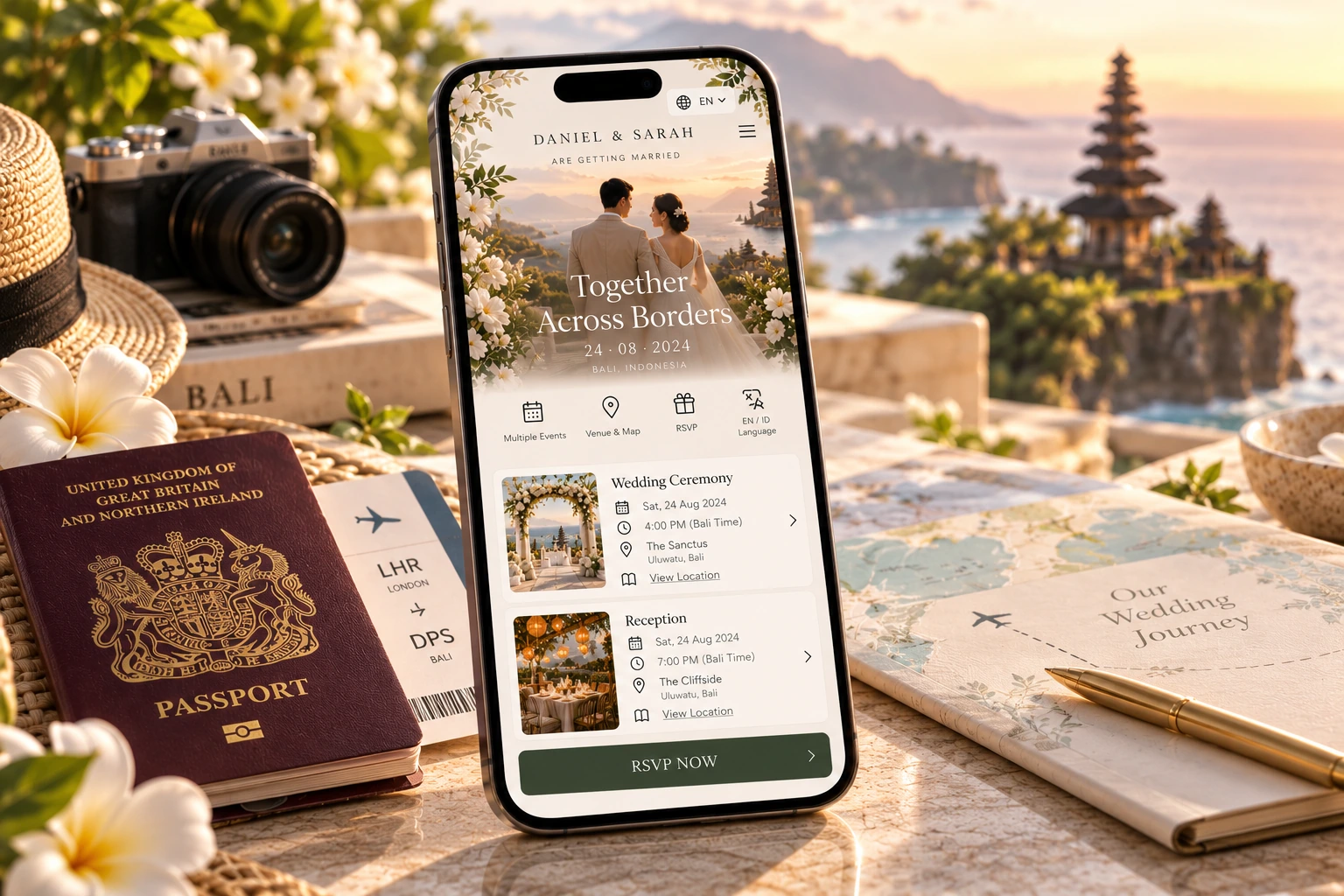
Language is one of the most important decisions for a wedding shared between countries.
Verlieb’s current builder includes a dedicated Languages & Translations stage. It is designed to let the couple select the invitation’s primary language and manage translated copy without creating separate versions of all the underlying media and section logic.
However, this capability is template-dependent.
The selected template controls the locales it supports. In the builder architecture, templates can declare their own default language, fallback language and available locales. Older compatible templates have their own legacy language capability, while newer templates may expose a different set.
That means you should not choose a design first and assume English and Bahasa Indonesia—or any other combination—will automatically be available afterward.
If language is important for your guest list, check template compatibility before committing to the design.
For a UK-Indonesia guest list, ask:
- Which language should be primary?
- Which guests genuinely need another language?
- Does the selected template support the languages required?
- Are the important operational sections translated, not merely the decorative introduction?
- Will event names, RSVP prompts and guest instructions still make sense in each version?
The purpose is not to translate every word simply because translation is possible. It is to make sure each guest can understand the decisions that affect them.
Translate practical information with the same care as the welcome text
Multilingual invitations often look polished at the top of the page and become inconsistent further down.
The names and opening message may be translated carefully, while the RSVP instructions, event labels or practical notes remain in another language.
For an international wedding, those operational details are usually more important than decorative copy.
Review the invitation language by section.
Check the event names.
Check location instructions.
Check RSVP labels and response wording.
Check meal options if you use them.
Check the message shown after a response.
Check any section that contains a direction or action the guest needs to follow.
Verlieb’s translation architecture is designed to reuse the invitation structure rather than duplicate every section and media item, which reduces the need to maintain separate pages. But the couple is still responsible for the quality and completeness of the actual translated content.
This article does not attempt to prescribe exact multilingual wording; that is a different editorial problem. The objective here is operational clarity.
Keep one source of truth for event changes
An international guest may receive information through several channels before the wedding: messages from the couple, a family group chat, a travel conversation and the formal invitation link.
Confusion starts when those sources disagree.
If a ceremony time changes, update the invitation before sending more messages about it.
If a venue changes, replace both the address and map destination.
If an RSVP deadline changes, update the actual RSVP configuration rather than merely mentioning the new date elsewhere.
A digital invitation is most valuable when guests can return to it and trust that it contains the current wedding information.
That is particularly important for guests who cannot casually ask someone local whether a time or venue is correct.
Test the invitation from the perspective of someone in the UK
Before publishing, do not review the invitation only as the person who built it.
Give the preview to someone who does not already know the wedding plan.
Ask them to answer practical questions:
What date should you travel around?
How many wedding events are you invited to?
What time does each event begin?
Which time zone are those times using?
Where is each venue?
Can you open the location from your phone?
What response does the couple need from you?
When is that response due?
If there is more than one language, can you find and understand the version intended for you?
If the tester has to contact you for an answer that the invitation was supposed to provide, improve the invitation before publishing it.
Verlieb’s publish workflow includes readiness checks around areas such as template assignment, required content, event information, section compatibility and multilingual completeness. Those technical checks are useful, but they cannot decide whether your communication is understandable to a real guest.
Human testing still matters.
What Verlieb can help with—and what it should not be expected to do
For a UK-Indonesia wedding, Verlieb can bring several pieces of guest communication into one invitation:
structured event details, dates and times, venue information, addresses, external map links, RSVP, guest-facing sections and template-supported language management.
That can substantially reduce the amount of basic wedding information spread across disconnected messages.
But the invitation should not be mistaken for a complete international travel platform.
The audited builder does not justify claims that Verlieb arranges visas, books accommodation, provides guest transport, automatically manages WhatsApp communication or guarantees universal bilingual support across every template.
Those boundaries are useful rather than limiting.
They make it easier to decide what the invitation should do exceptionally well: become the reliable source for the wedding information your guest needs to understand and act on.
Build the invitation around the questions an overseas guest will actually ask
A good international wedding invitation is not necessarily longer than a local one.
It is more deliberate.
The events are separated clearly.
Times have an obvious destination context.
Locations can be opened without searching manually.
The RSVP asks for decisions the couple actually needs.
Language support is checked against the chosen template rather than assumed.
And the invitation remains usable when a guest returns to it weeks or months later.
That is the right way to evaluate Verlieb for a wedding in Indonesia with guests travelling from the UK.
Start with the communication problem, not the feature list.
Once you know what an international guest must understand, Verlieb’s builder gives you a structured way to turn those requirements into an invitation that is easier to navigate, easier to update and easier for guests to trust.