
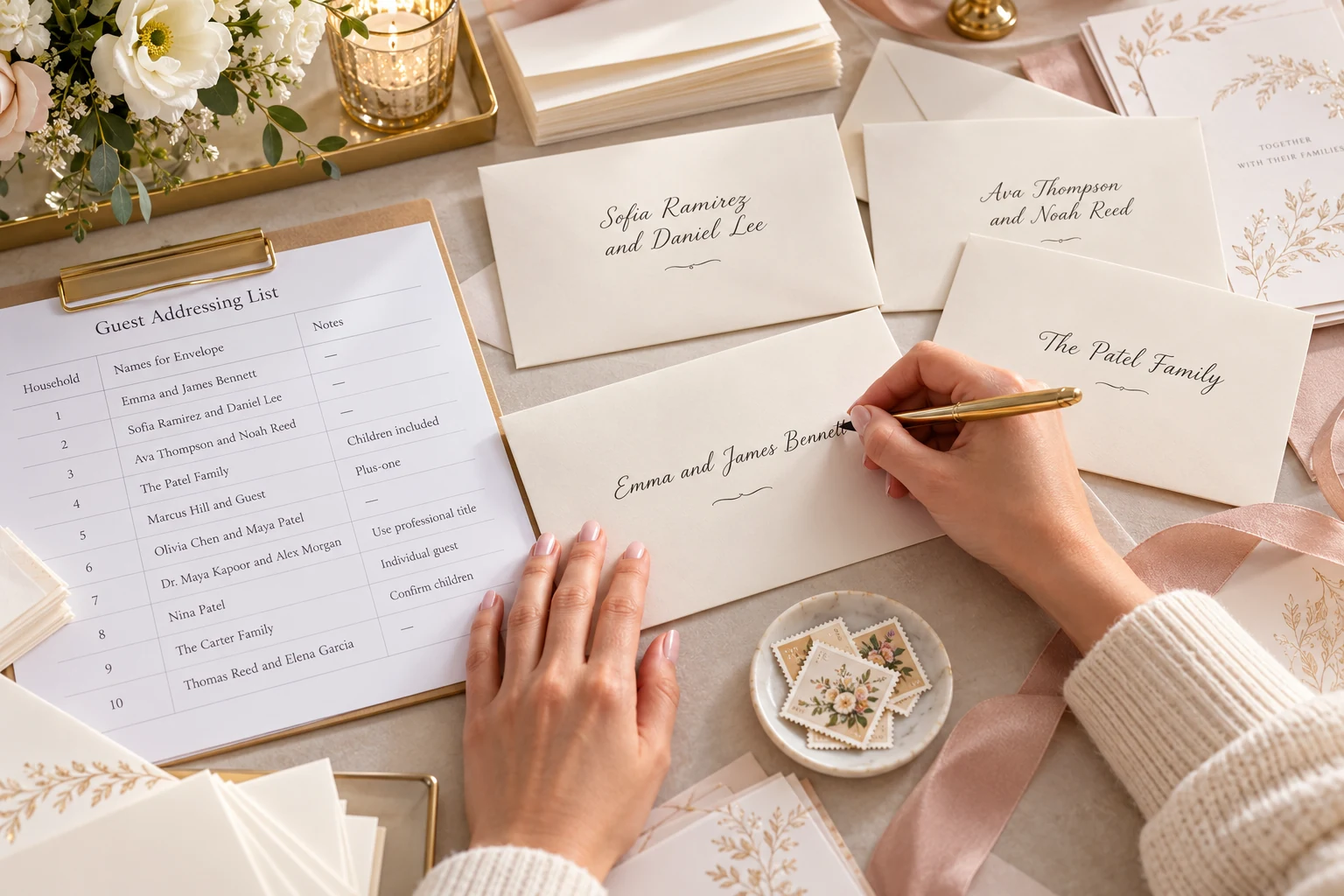
Addressing wedding invitations seems simple until you start working through the guest list.
A married couple may share a last name—or not. Two partners may use different titles. Some households include children, adult children, partners, or relatives with different surnames. Some guests prefer no title at all. Others use professional or gender-neutral titles that should be reflected correctly.
The clearest approach is not to memorize one rigid etiquette formula. It is to use a consistent system that answers two questions for every invitation:
Whose names should appear?
How should those names be written so the invitation is both respectful and unambiguous?
The best addressing style is one that fits the formality of your wedding, respects the names and titles your guests actually use, and makes it clear who the invitation includes.
Start With Accuracy, Not Tradition
Before deciding whether your invitations will feel formal or modern, make sure your guest data is correct.
For every invitee, confirm:
- full name;
- preferred first name;
- surname;
- title, if you plan to use titles;
- partner’s name, where applicable;
- household relationships;
- mailing address;
- whether children are included;
- whether a named guest or unnamed plus-one is included.
Do not assume surnames, marital status, titles, or name order.
A beautifully calligraphed envelope with the wrong name is still wrong.
If you are unsure how someone prefers to be addressed, asking is better than guessing.
Elegant digital invitations thoughtfully designed for a beautiful experience on every device.
Explore Templates
Decide How Formal Your Addressing Style Will Be
Wedding invitations can be addressed in several levels of formality.
A traditional approach may use titles and full names:
Mr. Daniel Carter and Ms. Lena Morris
A more contemporary approach may simply use both full names:
Daniel Carter and Lena Morris
For a relaxed wedding, first names may occasionally be appropriate on certain stationery, but full names are generally clearer for mailed invitations.
The important thing is consistency.
If you use titles for one household, do not randomly omit them for another unless there is a reason. If you use full first names rather than initials, follow the same pattern throughout the guest list.
You do not need to choose the most formal possible style simply because it is a wedding.
Choose the level of formality that matches the invitation design and the event itself.
Titles Are Optional Unless They Matter to the Guest
Traditional invitation etiquette often relies heavily on titles such as:
- Mr.
- Mrs.
- Ms.
- Mx.
- Dr.
Modern invitations do not have to use titles at all.
If you choose to use them, accuracy matters more than convention.
Use the title a guest actually prefers. Do not assign a title based only on gender, marital status, or appearance.
For professional titles such as doctor, judge, military rank, or clergy title, decide whether your invitation style will recognize those titles consistently.
If you do not know a guest’s preferred title, writing their full name without one is often cleaner than guessing.
Married Couples Who Share a Last Name
For a married couple with the same surname, there are several acceptable approaches depending on your level of formality.
A modern, clear format is:
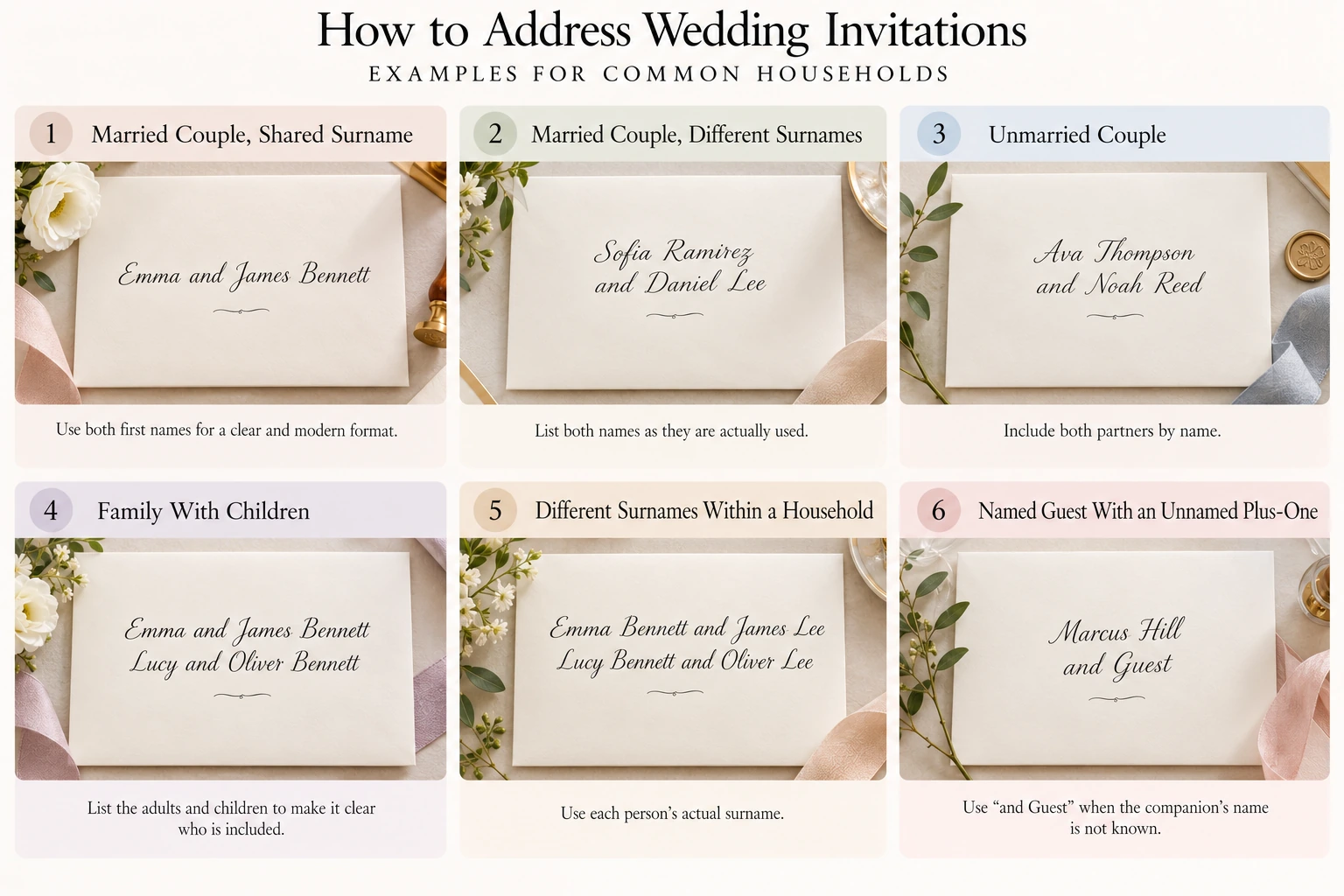
Emma and James Bennett
or:
Emma Bennett and James Bennett
If you are using titles:
Ms. Emma Bennett and Mr. James Bennett
Some very traditional forms combine a couple under one surname, but many couples prefer both individual names to remain visible.
Using both first names is generally clearer and more personal.
The same principle applies regardless of the genders of the spouses.
Married Couples With Different Last Names
When spouses use different surnames, list both names.
For example:
Sofia Ramirez and Daniel Lee
With titles:
Ms. Sofia Ramirez and Mr. Daniel Lee
There is no need to force a shared household name that the couple does not actually use.
If one partner has a professional title:
Dr. Sofia Ramirez and Daniel Lee
The order can follow your chosen system rather than an inflexible hierarchy.
You might use:
- alphabetical order;
- the person you know best first;
- the order used by the couple themselves.
Whatever system you choose, apply it consistently where practical.
Married Couples With the Same Gender
Addressing does not require a separate etiquette system for same-gender couples.
Use each person’s actual name and preferred title exactly as you would for any other couple.
For example:
Olivia Chen and Maya Chen
or:
Ms. Olivia Chen and Ms. Maya Chen
If they use different surnames:
Olivia Chen and Maya Patel
Avoid inventing gendered rules for deciding whose name should appear first.
The couple’s own preferred order, alphabetical order, or a consistent household convention all work.
Unmarried Couples Living Together
If two partners live together and both are invited, include both names on the invitation.
For example:
Ava Thompson and Noah Reed
You do not need to hide one partner behind an informal “and guest” if you know their name.
Naming both people makes the invitation feel more personal and avoids ambiguity.
If you use titles:
Ms. Ava Thompson and Mr. Noah Reed
Again, the order is flexible. Consistency is more important than following an outdated rule.
Couples Who Do Not Live Together
If both people are invited as a couple but live at different addresses, you have two practical choices.
You can send one invitation to the person with whom you have the primary relationship and name both guests on it, or send separate invitations when that makes more sense for your mailing system and the relationship.
From an addressing perspective, what matters is that both invited names are explicit.
If you are mailing one invitation, write both names even if only one address appears on the envelope.
When One Partner Has a Professional Title
Professional titles can create uncertainty because traditional etiquette often contains elaborate ordering rules.
You can keep it much simpler.
If you are using professional titles throughout your invitations, include the title with the appropriate name:
Dr. Maya Kapoor and Alex Morgan
If both use the same professional title:
Dr. Maya Kapoor and Dr. Alex Morgan
If your invitation style does not use titles generally, you can simply use full names:
Maya Kapoor and Alex Morgan
The important thing is not to elevate one partner in a way that makes the other look secondary unless that is part of a deliberately formal convention you are using consistently.
Guests Who Use Mx. or Another Preferred Title
If a guest uses Mx., use it exactly as you would Mr., Ms., or another title.
For example:
Mx. Jordan Ellis
Do not replace a known preferred title with one you consider more traditional.
If someone uses another title or form of address, follow their preference where appropriate.
And if titles make your addressing system unnecessarily complicated, using full names without titles is completely acceptable for many contemporary weddings.
Families With Children
When parents and children are all invited, the names should make that clear.
You can address the household broadly:
The Bennett Family
This is simple, but it is less precise when households are complex.
A more explicit version might list the adults on the envelope and children on the invitation or inner envelope if you are using one:
Emma and James Bennett
Lucy and Oliver Bennett
For families in which not everyone shares a surname, avoid forcing a single family name.
You might write:
Emma Bennett and James Lee
Lucy Bennett and Oliver Lee
The more complex the household, the more useful individual names become.
Children With Different Surnames
Blended families and households with multiple surnames are common.
Do not assume every child shares a parent’s surname.
If children are included, use the names they actually use.
For example:
Maya Collins and David Green
Sophie Collins and Leo Green
If a household label such as “The Green Family” would inaccurately erase someone’s surname, individual names are preferable.
Clarity matters more than fitting the household into a traditional template.
Adult Children Living With Their Parents
An adult child living at the same address is not necessarily part of the parents’ invitation for addressing purposes.
If the adult child is independently invited, consider naming them explicitly.
Depending on your invitation system, you might:
- include their full name on the same household invitation;
- send a separate invitation to the same address.
Either can work.
The key is that an adult guest should not have to guess whether they were included because their parents received an invitation.
Siblings or Roommates at the Same Address
People sharing an address do not automatically form one invitation household.
Two adult siblings, roommates, or unrelated adults may each receive individual invitations even if the mailing address is identical.
If you do combine them, list each invited person clearly:
Rachel Kim and Daniel Kim
or:
Rachel Kim and Priya Shah
Do not use “The Kim Family” when the people involved are independent adult guests and that wording could create confusion about who is included.
Named Guests Are Better Than “And Guest” When You Know the Name
If someone is invited with a specific partner or companion whose name you know, use that person’s name.
For example:
Thomas Reed and Elena Garcia
is preferable to:
Thomas Reed and Guest
when Elena is the person actually being invited.
“And Guest” is most useful when the invitation genuinely includes an unnamed companion.
Using names wherever possible makes invitations feel more intentional and prevents confusion during RSVP collection.
How to Address an Unnamed Plus-One
If a guest is invited to bring a companion but you do not know who that person will be, the invitation can indicate:
Marcus Hill and Guest
On more formal invitations, some couples prefer to place the guest’s name on the primary envelope and indicate the plus-one elsewhere in the invitation suite or RSVP system.
Whichever method you use, make sure the invitation and RSVP process communicate the same thing.
The addressing should not imply one guest while the RSVP form unexpectedly allows two.
Single Guests Without a Plus-One
For a guest invited individually, simply address the invitation to that person:
Nina Patel
or:
Ms. Nina Patel
There is no need to add wording that emphasizes the absence of a guest.
The name itself communicates who the invitation is addressed to.
Keep the envelope neutral and courteous.
What About “The Smith Family”?
A household-style address such as:
The Smith Family
can be perfectly appropriate when:
- everyone in the household is invited;
- the household actually uses that surname;
- there is little risk of ambiguity.
It becomes less useful when:
- family members use different surnames;
- adult children have separate invitation status;
- only some children are invited;
- the household includes relatives or partners whose inclusion may be unclear.
When in doubt, specific names are safer than a broad family label.
Outer and Inner Envelopes
Some formal invitation suites use both an outer envelope and an inner envelope.
The outer envelope is used for mailing and generally carries the formal household address.
The inner envelope can be more specific about exactly who is invited.
For example, an outer envelope might say:
Mr. and Mrs. James Bennett
while an inner envelope lists:
Emma, James, Lucy, and Oliver
Modern weddings frequently use only one envelope, and that is completely workable.
If you use a single-envelope system, make the addressing sufficiently clear that guests do not need an inner envelope to understand who is included.
If You Use Only One Envelope, Be More Specific
One-envelope invitation suites are common.
Without an inner envelope, the names on the mailing envelope carry more responsibility.
Rather than:
The Bennett Family
you may prefer:
Emma and James Bennett
Lucy and Oliver Bennett
when you want to remove any ambiguity.
The exact layout depends on the envelope size and calligraphy style, but clarity should not be sacrificed for symmetry.
Formal Names Versus Everyday Names
Decide whether invitations will use legal names, full preferred names, or familiar names.
For example, someone legally named:
Jonathan Alexander Reed
may use:
Jonathan Reed
in normal formal settings.
Another guest may strongly prefer:
Jon Reed
There is no rule that wedding stationery must reproduce every legal name exactly as it appears on identification documents.
Use the name your guest recognizes as their own and that fits the tone of your invitation.
Avoid nicknames only when they feel too casual for your chosen stationery style.
Middle Names Are Usually Optional
Middle names can add formality, but they are rarely necessary for guest addressing.
You might use them when:
- your invitation suite is very formal;
- two guests have similar names;
- the person commonly uses their middle name;
- you simply prefer the appearance.
Otherwise, first name and surname are usually enough.
Do not create inconsistency by using middle names for some guests solely because you happen to know them.
Avoid Initials Unless There Is a Specific Reason
Full names generally feel more personal and are easier to understand than initials.
Instead of:
Mr. J. Bennett and Ms. E. Bennett
prefer:
James Bennett and Emma Bennett
unless the guest genuinely uses an initial as part of their normal name.
The same principle applies to professional titles and middle initials.
Clarity should come before ceremonial complexity.
Name Order Does Not Need to Follow Gender
Older etiquette systems often used gender to determine whose name appeared first.
You do not need to follow that convention.
A modern system might use:
- alphabetical order;
- the person closest to the couple first;
- the order in which the guests normally present their names;
- one consistent internal rule.
For example, both of these are acceptable:
Anna Brooks and Michael Lewis
Michael Lewis and Anna Brooks
What matters most is that neither person is accidentally omitted or treated as an unnamed extension of the other.
Divorced, Separated, or Remarried Parents and Relatives
Address each household according to its current reality.
Do not rely on outdated family relationships in your records.
If two people no longer share a household, they should generally receive invitations appropriate to their current addresses.
If someone has remarried or changed their surname, use their current preferred name.
This is another reason to verify guest data before envelopes are ordered or calligraphy begins.
Widowed Guests
Use the name and title the guest currently prefers.
Some widowed guests continue using a married surname or traditional form of address. Others prefer their own first name and surname.
Do not assume.
When uncertain, ask the guest or a close family member who will know the preferred form.
Guests With Compound or Hyphenated Surnames
Keep compound, double, and hyphenated surnames intact.
For example:
Lucia García Márquez
Emily Carter-Jones
Do not shorten a surname for visual convenience.
If a long name creates layout challenges, adjust typography or line breaks rather than changing the guest’s name.
Cultural Naming Conventions Deserve Care
Not every name follows the same first-name/last-name structure.
Different cultures may use:
- multiple family names;
- patronymics;
- matronymics;
- family names placed first;
- names without a conventional Western surname;
- honorifics with their own rules.
Do not rearrange a guest’s name simply to make it fit an English-language addressing convention.
Use the order and form the person normally uses in formal correspondence.
If you are unsure, ask.
International Addresses Need Their Own Format
When invitations are being mailed internationally, the guest-name line and the postal address serve different purposes.
Keep the guest’s name respectful and consistent with the invitation style, but format the mailing address according to the destination country’s postal conventions.
Do not assume your domestic address format works everywhere.
This is especially important for:
- postal codes;
- province or region names;
- building numbers;
- apartment numbers;
- country names.
Check the mailing requirements before final envelopes are printed.
Handwritten, Calligraphed, and Printed Envelopes All Follow the Same Name Logic
Whether the envelope is:
- professionally calligraphed;
- digitally printed;
- handwritten;
- printed with a guest-data merge;
the addressing rules should come from the same source list.
Do not maintain separate versions of guest names for different vendors unless necessary.
A single clean guest-addressing sheet reduces errors.
Before production, review the exact export that will be used for printing or calligraphy.
Build a Consistent Guest-Addressing Sheet
A useful addressing spreadsheet or database might include:
- household ID;
- invitee 1 full name;
- invitee 1 preferred title;
- invitee 2 full name;
- invitee 2 preferred title;
- children or additional named invitees;
- display name for envelope;
- address line 1;
- address line 2;
- city;
- region/state;
- postal code;
- country;
- notes.
The important field is the final display name.
Do not expect your stationery designer or calligrapher to infer how names should be combined from raw guest-list data.
Decide that yourself before handing over the file.
Proof Every Name Separately From the Address
Address proofing should happen in two passes.
First, check the names.
Confirm:
- spelling;
- accents and diacritical marks;
- titles;
- surnames;
- household groupings;
- plus-one wording;
- children included.
Then check the postal addresses.
This is more reliable than trying to proof every detail at once.
A typo in a guest’s name is personal. A typo in the postal address can prevent delivery. Both deserve a deliberate review.
Watch for Accents, Apostrophes, and Special Characters
Names should be reproduced correctly.
Do not casually remove:
- accents;
- umlauts;
- apostrophes;
- hyphens;
- spaces;
- capitalization that is part of the name.
Examples might include:
Zoë
O’Connor
García
Müller
Make sure the font you choose includes the characters you need before printing begins.
A font that cannot reproduce your guests’ names accurately is not the right font for the job.
Do Not Let Design Make the Address Hard to Read
Envelope addressing is part of the stationery design, but it is also functional.
Names and mailing addresses should remain legible.
Be careful with:
- extremely small type;
- very pale ink;
- highly decorative script;
- tight line spacing;
- unusual letterforms;
- metallic printing with low contrast.
If the envelope is beautiful but difficult for the guest or postal service to read, the design is working against its purpose.
Use the Same Invitation Logic in Your RSVP System
The names on the invitation and the guest records in your RSVP system should agree.
If the envelope names:
Daniel Lee and Sofia Ramirez
your RSVP system should recognize both people.
If the invitation says:
Marcus Hill and Guest
the RSVP system should allow Marcus to respond for two people.
If children are named on the invitation, the RSVP should account for them where needed.
Addressing and RSVP design are separate tasks, but inconsistent guest records create unnecessary confusion.
Common Addressing Mistakes to Avoid
A few problems cause a disproportionate amount of confusion:
- assuming a married couple shares a surname;
- using the wrong title;
- writing “and Guest” when the partner’s name is known;
- using a family surname that does not represent everyone in the household;
- omitting invited children from a household where inclusion is otherwise unclear;
- treating adult children as automatically included in their parents’ invitation;
- shortening or rearranging culturally specific names;
- using inconsistent formality across the guest list;
- sending guest data to the printer before it has been proofed.
Most of these mistakes come from making assumptions rather than from choosing the “wrong” etiquette rule.
A Simple Addressing Standard Works Better Than Dozens of Exceptions
Before you format the full guest list, write down your own rules.
For example:
- use full names;
- no titles except professional titles;
- list both partners by name;
- use named partners instead of “and Guest” whenever known;
- list invited children explicitly;
- use each person’s actual surname;
- use one envelope only;
- preserve accents and preferred name order.
Your rules may be more formal or more relaxed than this.
What matters is deciding once rather than reinventing the format for every household.
Clear and Respectful Beats Perfectly Traditional
There is no single addressing formula that works for every modern household.
Families and relationships are varied. Names do not always follow one structure. Titles are personal. Couples may or may not share surnames. Adults living at the same address may belong on separate invitations.
That is why the most reliable standard is straightforward:
Use the names people actually use, identify every invited person clearly, and apply your chosen level of formality consistently.
If an old etiquette convention conflicts with accuracy or clarity, accuracy should win.
Your guests should open the envelope and immediately recognize themselves in it.
That is ultimately what good invitation addressing is meant to accomplish.