
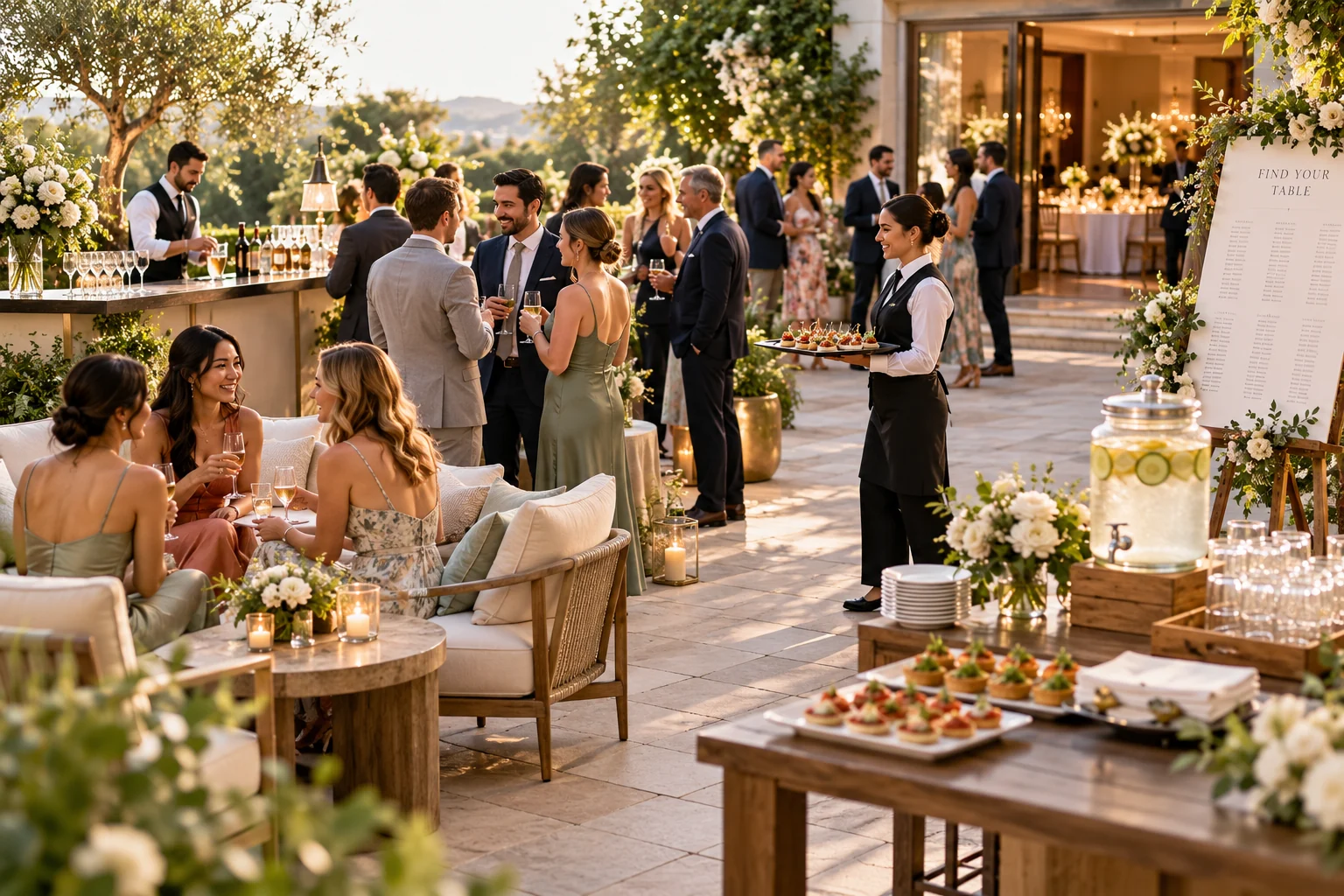
A good wedding cocktail hour rarely feels complicated to the people attending it.
Guests leave the ceremony, find a drink, eat something, settle into conversation, perhaps explore the venue, and eventually move into dinner without wondering what they are supposed to do next.
That apparent simplicity is usually the result of thoughtful planning.
Cocktail hour sits in an important transition between the ceremony and the reception. It may give the couple time for photographs, allow the venue to reset a space, create a natural arrival window for dinner, or simply give guests a chance to relax before the next part of the celebration.
Its purpose is not to keep people occupied while something else happens.
The goal is to make the transition itself feel like part of the wedding.
Start by Deciding What the Cocktail Hour Needs to Accomplish
Before choosing signature drinks or passed appetizers, determine why the cocktail hour exists in your schedule.
It may need to:
- give the couple time for portraits;
- allow family photographs after the ceremony;
- create time for the reception room to be reset;
- move guests from one part of the venue to another;
- bridge the gap between ceremony and dinner;
- give guests time to check the seating display;
- allow everyone to arrive before formal reception events begin.
Different purposes create different planning needs.
If the ceremony and reception are in adjacent spaces and no room reset is required, cocktail hour can be short and simple.
If guests must travel across a property while the couple takes photographs and the venue changes over a ceremony room, you need a more substantial plan.
The right cocktail hour is not the one with the most elements.
It is the one that comfortably covers the transition your wedding actually requires.
Elegant digital invitations thoughtfully designed for a beautiful experience on every device.
Explore Templates
Plan the Duration Before Planning the Details
Many weddings use roughly an hour for cocktails, but the correct length depends on what needs to happen during that period.
Think backward from the reception.
Ask:
- When should guests be seated for dinner?
- How much photography remains after the ceremony?
- Does the venue need time to reset?
- Do guests need to move to another building or location?
- Will there be a receiving line or other post-ceremony interaction?
- Does transportation operate between ceremony and reception?
- Will the couple join cocktail hour or arrive near the end?
Then build the duration around those needs.
Do not automatically extend cocktail hour because more time sounds luxurious.
Extra time is only comfortable when guests have enough food, drinks, seating, shelter, and something appropriate to do.
A Longer Cocktail Hour Requires More Support
A 45- or 60-minute transition behaves differently from a much longer one.
As cocktail hour grows longer, guests become more likely to need:
- substantial food;
- comfortable seating;
- water;
- shade or weather protection;
- restrooms nearby;
- more varied nonalcoholic drinks;
- clear information about what happens next.
People who happily stand with a drink for 30 minutes may be less comfortable doing so for 90.
If the schedule requires a long gap, treat it as a genuine hosted event rather than a holding period.
Avoid an Unexplained Gap After the Ceremony
One of the fastest ways to make cocktail hour feel awkward is to leave guests uncertain about where to go.
When the ceremony ends, the next step should be obvious.
That may happen through:
- an officiant announcement;
- venue staff opening the route to the cocktail area;
- visible signage;
- ushers guiding guests;
- servers appearing with drinks;
- the natural layout of the property.
Guests should not be left standing near the ceremony asking each other whether they are supposed to leave.
A smooth cocktail hour begins with a smooth handoff from the ceremony.
Think About the Guest Journey, Not Just the Cocktail-Hour Area
Walk the route as a guest would experience it.
Start at the ceremony seat.
Then ask:
- Where does the guest go when the ceremony ends?
- How far do they walk?
- Are there stairs, gravel, grass, or uneven surfaces?
- Where do they first see drinks?
- Where is the food?
- Where can they sit?
- Where are the restrooms?
- Where do they find the seating chart or escort cards?
- How do they know when it is time to enter the reception?
This exercise often reveals problems that are invisible on a floor plan.
A beautiful cocktail garden may be less successful if guests must walk a long distance in formal shoes without knowing where they are going.
A compact indoor area may work extremely well if everything is intuitive.
Do Not Create a Bottleneck at the First Thing Guests See
Imagine 120 people leaving the ceremony at the same time and reaching one bar.
Even excellent service can feel slow when everyone wants the same thing at once.
Look for pressure points at:
- bars;
- welcome-drink stations;
- escort-card displays;
- food stations;
- narrow entrances;
- coat-check areas;
- restrooms;
- doors leading into the reception.
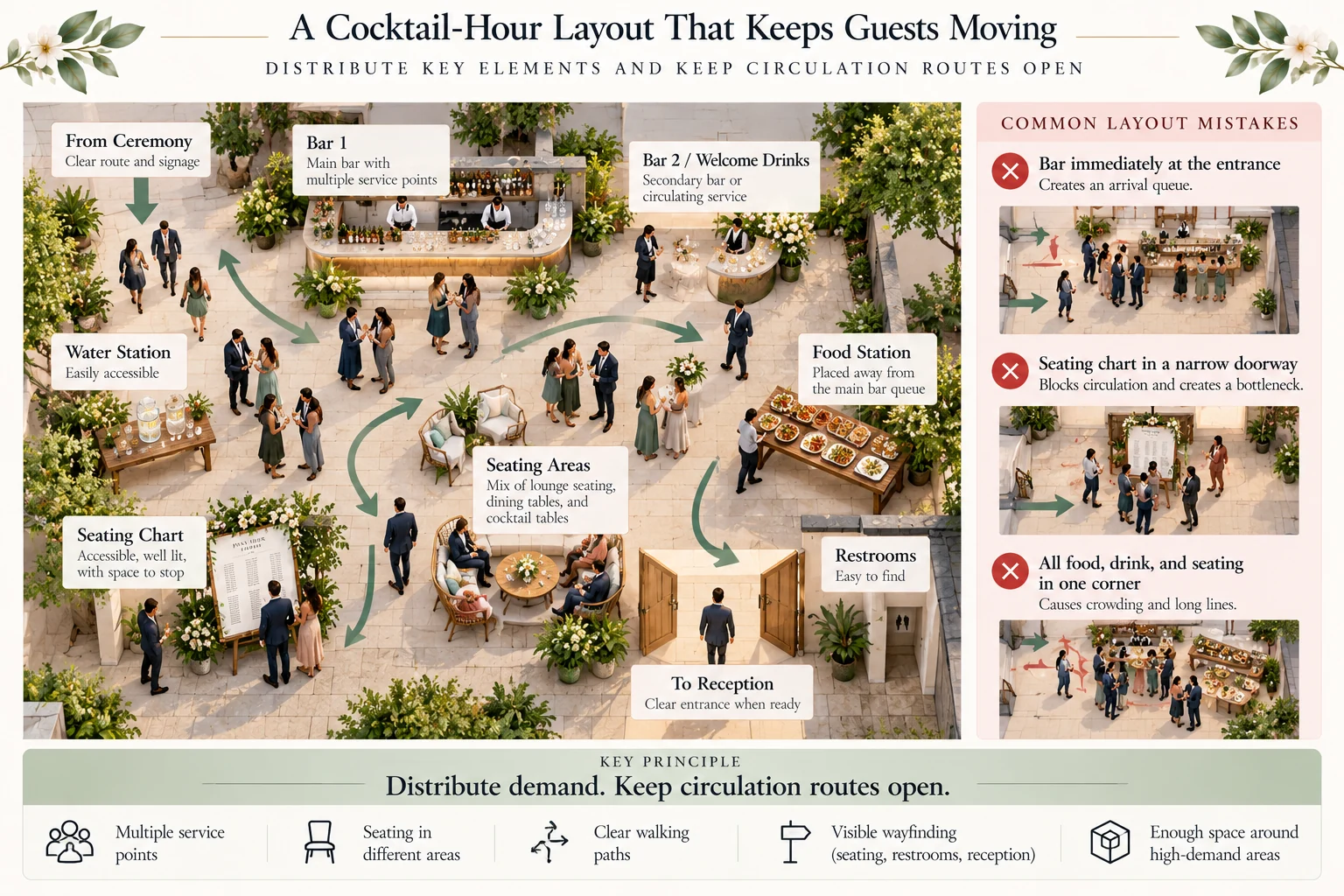
Where possible, distribute demand.
For example, guests might encounter circulating water or sparkling wine before reaching the main bar. Passed appetizers can move through the room rather than requiring everyone to queue at one table.
The objective is not to eliminate every line.
It is to avoid designing the entire cocktail hour around one unavoidable line.
The Bar Should Match the Number and Movement of Guests
Bar planning is partly about beverages and partly about throughput.
A beautiful bar with an elaborate menu can still create a poor guest experience if service takes too long.
Discuss with your venue or beverage provider:
- expected guest count;
- number of bartenders;
- number of service points;
- whether beer and wine can be served separately;
- whether signature drinks can be prepared efficiently;
- whether water is available without waiting at the bar;
- whether guests will arrive all at once.
If the venue regularly hosts weddings of your size, ask how they typically prevent the initial rush.
Practical service matters more than an oversized drink menu.
Signature Drinks Should Be Easy to Order and Easy to Serve
A signature cocktail can add personality, but it does not need to become a miniature mixology performance.
The best options for a busy cocktail hour are generally drinks that can be served consistently and efficiently.
Ask the bar team whether your chosen drink:
- requires many individual preparation steps;
- needs a complicated garnish;
- can be partially batched where appropriate;
- slows down service;
- uses ingredients the venue can handle reliably.
A drink can still feel special without requiring several minutes of preparation for every guest.
If efficiency matters, one or two well-chosen signature options are often more useful than a long custom menu.
Give Non-Drinkers Real Choices
“Bar” should not mean “alcohol plus water.”
Provide appealing options for guests who do not drink alcohol, are driving, are pregnant, take medications, are underage, or simply want something different.
Depending on the wedding, that might include:
- sparkling water;
- flavored water;
- lemonade;
- iced tea;
- alcohol-free spritzes;
- mocktails;
- soft drinks;
- coffee or tea where appropriate.
These options do not need to imitate cocktails.
They simply need to feel intentional.
And make them easy to find. A nonalcoholic menu that exists only if someone specifically asks a bartender is less welcoming than clearly visible choices.
Water Should Be Immediately Accessible
Water is one of the simplest cocktail-hour details and one of the easiest to underestimate.
Guests may have:
- sat through an outdoor ceremony;
- walked across the property;
- been traveling;
- had champagne before the ceremony;
- arrived in warm formal clothing.
Do not make everyone queue at the bar for water.
Depending on the venue, water might be available through:
- self-service dispensers;
- glasses set at stations;
- circulating servers;
- bottles where appropriate.
This matters especially at outdoor and warm-weather weddings.
Food Should Arrive Early
If cocktail hour includes food, guests should not spend the first half wondering when it will appear.
People often arrive hungry, particularly when the ceremony falls near a normal mealtime.
Coordinate with the caterer so the first appetizers can begin circulating soon after guests enter the cocktail space.
The same principle applies to stations.
They should be ready when guests are ready for them.
Cocktail hour feels more generous when hospitality begins immediately rather than after a long setup delay.
Choose Food That Can Actually Be Eaten While Socializing
Cocktail-hour food often has to function without a dining table.
That means practicality matters.
Ask whether each item can be eaten:
- in one or two bites;
- without a knife;
- without balancing several components;
- without excessive dripping or crumbling;
- while holding a drink;
- while standing.
A dish may taste excellent but still be awkward for this format.
If a menu item requires more attention, provide tables, small plates, cutlery, or seating that makes it realistic to eat comfortably.
Passed Appetizers and Stations Solve Different Problems
Passed appetizers bring food to guests.
Stations bring guests to food.
Both can work well, but they create different movement patterns.
Passed appetizers can help when:
- guests are distributed across a large space;
- you want food to reach people who are seated;
- you want to minimize queues;
- the menu works in small portions.
Stations can help when:
- the food is prepared or assembled in front of guests;
- portions are more substantial;
- guests benefit from choosing what they want;
- the station itself adds visual or culinary interest.
You can also combine them.
For example, passed bites can start immediately while one or two stations provide something more substantial.
Consider Whether the Food Matches the Length of the Gap
Food quantity should make sense in relation to both the schedule and the meal that follows.
If dinner begins soon after cocktail hour, appetizers may only need to take the edge off guests’ hunger.
If dinner is later or cocktail hour is extended, guests may need more.
Think about:
- ceremony time;
- last likely meal before arrival;
- cocktail-hour duration;
- dinner start time;
- whether alcohol is being served;
- how substantial dinner will be.
Ask your caterer to recommend quantities based on the complete schedule rather than choosing appetizers in isolation.
Dietary Needs Still Matter During Cocktail Hour
It is easy to focus dietary planning on dinner and forget the first round of food.
If a guest cannot eat any cocktail-hour options, an hour that feels abundant to everyone else may feel surprisingly long.
Discuss common dietary needs with your caterer and identify which items work for different guests.
Where appropriate, staff should know which appetizers contain major allergens or meet specific dietary requirements.
If a guest has a serious allergy or another need requiring special handling, coordinate directly with the caterer rather than assuming a generic menu label is enough.
Make Sure Guests Can Tell What They Are Eating
Passed appetizers should not require a guessing game.
Servers can identify each item clearly as they offer it.
Stations can use concise labels.
This is useful for everyone and especially helpful when ingredients are not obvious.
You do not need lengthy menu descriptions throughout the room.
Just enough information for guests to understand the choice.
Seating Matters Even During a Mostly Standing Event
Cocktail hour is often designed around standing and mingling, but not every guest can or wants to stand for the entire time.
Provide some seating.
This is particularly important for:
- older guests;
- pregnant guests;
- people with mobility limitations;
- guests wearing less comfortable formal shoes;
- anyone who simply needs a break.
You do not necessarily need a chair for every person if the event is intentionally conversational and mobile.
But “cocktail-style” should not mean “no place to sit.”
Mix Different Types of Seating and Surfaces
A useful cocktail-hour layout may combine:
- lounge chairs;
- sofas;
- benches;
- standard-height tables;
- cocktail tables;
- dining chairs;
- ledges or built-in venue seating.
High cocktail tables are useful for placing drinks and small plates, but they are not a substitute for actual chairs.
Think about both resting and eating.
Someone may not need a full lounge area, but they should be able to set down a glass without searching for an empty windowsill.
Do Not Hide Seating Far Away From the Action
Seating is less useful if guests who use it feel removed from the event.
Place some comfortable seating where people can still:
- talk with others;
- hear the music;
- access food;
- see the room;
- move toward the reception when called.
This is especially relevant for older relatives and guests with mobility considerations.
The goal is inclusion, not creating a separate waiting area.
The Layout Should Encourage Movement Without Forcing It
A strong cocktail-hour layout gives guests reasons to move naturally.
For example:
- bar in one area;
- passed food circulating throughout;
- seating distributed around the space;
- escort cards positioned somewhere accessible;
- a view, terrace, or focal point nearby;
- music audible without dominating.
Avoid putting every attraction in the same corner.
But also avoid spreading things so far apart that guests have to travel continuously just to get food and drinks.
Good flow usually feels intuitive rather than choreographed.
Leave Enough Space Around Food and Drink Areas
Cocktail tables, decor, signs, and lounge furniture can quickly fill a room.
Remember that the space also needs to hold moving people.
Guests will stop to:
- greet each other;
- form small conversation groups;
- queue briefly;
- look at seating information;
- accept food from servers.
Do not design only for furniture footprints.
Design for the temporary clusters of people that form around them.
Music Should Create Atmosphere, Not Compete With Conversation
Cocktail-hour music has a different job from dance-floor music.
Guests are meeting, reconnecting, and talking.
The music should support that atmosphere.
Depending on the wedding, this could be:
- a string ensemble;
- jazz trio;
- acoustic musician;
- pianist;
- DJ;
- curated playlist.
The genre matters less than the effect.
Guests should not have to raise their voices significantly to speak to someone nearby.
Coordinate volume with the musicians, DJ, or venue and remember that an empty room during soundcheck may behave differently once filled with guests.
Live Music Needs Its Own Practical Space
If you use live musicians, include their needs in the floor plan.
Consider:
- power;
- shelter;
- sound equipment;
- performance area;
- weather;
- guest circulation;
- distance from the bar;
- transition timing.
Do not place performers where a bar queue will form directly in front of them or where servers need to pass continuously through the setup.
Atmosphere works best when the operational details are invisible.
Entertainment Is Optional
Cocktail hour does not automatically need games, performers, interactive displays, or activities.
Conversation may be enough.
Your guests have just witnessed the ceremony and are entering a room full of people they know or are about to meet.
Additional entertainment can be useful when it genuinely fits the wedding, but it should not be added because you are afraid guests will become bored after ten minutes.
Ask whether the activity improves the experience or simply gives people another thing to navigate.
If You Add an Activity, Do Not Make Participation Necessary
Examples might include:
- a guest book;
- photo booth;
- live illustrator;
- audio guest book;
- lawn games;
- tasting station.
These work best as optional layers.
Guests who want to participate can.
Guests who prefer to have a drink and talk should not feel that they are missing the main experience.
Cocktail hour should still function even if half the room ignores the activity.
Decide When Guests Will Find Their Tables
Cocktail hour is often the moment when guests encounter:
- escort cards;
- a seating chart;
- table assignments.
Choose the location carefully.
The display should be:
- easy to find;
- large enough to read;
- well lit;
- accessible;
- positioned where people can pause without blocking a doorway.
If every guest must crowd around one small sign immediately before dinner, the transition can become slow.
Allow people to discover their table assignment during cocktail hour when possible.
Alphabetical Seating Displays Are Usually Easier to Search
If you have a large guest list, consider organizing seating information so guests can find themselves quickly.
A display organized by guest name can be easier to scan than one that requires checking every table.
Whatever system you choose, test it from the guest’s perspective.
Can someone walk up, find their name in a few seconds, and move away?
That matters more than whether the display photographs beautifully.
Do Not Put the Seating Display in a Traffic Chokepoint
A seating chart directly inside a narrow doorway may look convenient on paper.
In practice, people stop.
Then people behind them stop.
Soon the entrance becomes a queue.
Give the display breathing room.
Guests should be able to approach it, step aside, and discuss their table number without preventing others from entering the reception area.
Plan for Bags, Coats, and Personal Belongings
Depending on the season and venue, guests may arrive at cocktail hour carrying:
- coats;
- umbrellas;
- handbags;
- ceremony programs;
- gifts;
- children’s items.
Think about where those things go.
A coat check, designated storage area, or clear transition into the reception can make guests significantly more comfortable.
At an outdoor wedding, an unexpected weather change may also create a sudden need for umbrella or wrap storage.
These details affect how effortless the hour feels even though they are rarely part of the decorative plan.
Keep Restrooms Easy to Find
Guests should not need to ask repeatedly where the restrooms are.
If the location is not obvious, use discreet signage or have staff ready to direct people.
This becomes more important when:
- the venue is large;
- the cocktail area is outdoors;
- guests moved from another building;
- accessible restrooms follow a different route.
Cocktail hour may be the first time guests explore the venue independently, so simple wayfinding helps.
Outdoor Cocktail Hours Need a Real Weather Plan
An outdoor terrace, lawn, courtyard, or garden can be ideal for cocktails.
But the backup plan needs to be capable of hosting the event—not merely existing on paper.
Consider:
- rain;
- strong sun;
- heat;
- cold;
- wind;
- wet ground;
- insects;
- darkness later in the season.
Ask where guests actually go if the weather changes.
Then evaluate the backup area using the same standards as the original plan:
- Can everyone fit?
- Is there enough seating?
- Can bars operate there?
- Can food circulate?
- Can musicians move?
- Is the seating display protected?
- Is the route accessible?
A weather plan is only useful if the guest experience still works.
Shade Can Matter Even When It Is Not Hot
Guests in formal clothing may be standing outside longer than expected.
Direct sun can become uncomfortable quickly.
Look at the cocktail-hour area at the actual time of day your wedding will occur.
A terrace that is shaded during a morning site visit may be in full sun at 5:00 p.m.
If necessary, discuss:
- umbrellas;
- covered areas;
- tents;
- indoor access;
- water placement.
Comfort should be part of the layout, not an emergency adjustment.
The Couple Does Not Have to Miss the Entire Cocktail Hour
Some couples assume cocktail hour exists because they must spend every minute taking photographs.
That is not mandatory.
If joining guests matters to you, build photography around that goal.
Options include:
- taking many portraits before the ceremony;
- completing family-photo combinations efficiently;
- joining the final portion of cocktail hour;
- entering cocktails briefly before dinner;
- scheduling selected portraits later.
Discuss the tradeoffs with your photographer before the wedding day.
Do not discover after the ceremony that your photography plan automatically removes you from an hour you wanted to experience.
If You Will Be Away, Guests Should Still Feel Hosted
The couple’s absence should not make cocktail hour feel like waiting for the hosts to arrive.
Hospitality can come from:
- attentive service;
- food available immediately;
- music;
- comfortable space;
- clear timing;
- family or wedding-party members mingling naturally.
You do not need a formal host making announcements.
The environment itself should communicate that the celebration is already underway.
Do Not Schedule Too Many Formal Moments During Cocktail Hour
Cocktail hour works well because it usually has a loose rhythm.
If you fill it with:
- formal introductions;
- speeches;
- group photographs;
- mandatory activities;
- structured announcements;
- repeated transitions,
it stops functioning as a relaxed social interval.
Save major attention-demanding moments for places in the timeline where guests are already gathered and ready to listen.
Cocktail hour can contain small features without becoming another ceremony.
Children Need Something More Than Tall Cocktail Tables
If children are attending, consider how the space works for them.
They may need:
- accessible drinks;
- suitable food;
- chairs;
- room to move safely;
- supervision around steps, pools, open flames, or outdoor boundaries.
You do not necessarily need children’s entertainment.
But the physical setup should not assume every guest is adult-height and comfortable standing.
Accessibility Should Be Part of the Main Route
A guest using a wheelchair, mobility aid, or another accessibility accommodation should be able to experience the same cocktail hour—not a separate version of it.
Check:
- step-free route from ceremony;
- surface conditions;
- door widths;
- accessible seating;
- bar/service height where relevant;
- restroom access;
- distance between spaces.
If an alternative route is necessary, make sure someone knows how to guide the guest without confusion.
The accessible path should be planned before the wedding day.
Coordinate Cocktail Hour With Photography
Photography and cocktail-hour logistics often happen simultaneously.
Your photographer may be working through:
- couple portraits;
- wedding-party portraits;
- immediate-family photographs;
- extended-family photographs.
Every extra photo combination consumes time.
Create the family-photo list in advance and tell the relevant people when and where they are needed.
Otherwise, valuable time can disappear while someone searches for an uncle who has already gone to the bar.
A more efficient photography plan can improve both the couple’s experience and the cocktail-hour timeline.
Coordinate With the Venue Before Guests Enter the Reception
The end of cocktail hour should be planned just as carefully as the beginning.
The reception space needs to be genuinely ready before guests are invited in.
Confirm who determines that moment.
It might be:
- planner;
- venue coordinator;
- catering captain;
- master of ceremonies;
- DJ.
Someone should know when:
- tables are ready;
- candles are lit;
- water is poured where applicable;
- staff are positioned;
- the couple is ready;
- introductions can begin.
Do not open the room simply because the scheduled time has arrived if the operational pieces are not ready.
Give Guests a Clear Signal That Cocktail Hour Is Ending
Guests should not need to notice that everyone else has disappeared.
Possible transition cues include:
- staff opening the reception doors;
- an announcement from the DJ or band;
- coordinator guidance;
- a subtle lighting or music shift;
- servers directing guests toward dinner.
The signal should be clear enough to create movement without feeling like an evacuation.
If guests already know their table assignments, the transition becomes easier.
Build a Small Buffer Into the Transition
Moving a large group takes time.
If dinner service needs guests seated at 7:00, do not necessarily wait until exactly 7:00 to invite them into the room.
People will:
- finish conversations;
- collect drinks;
- check the seating chart;
- visit restrooms;
- find their tables.
Coordinate with your venue and caterer so the timeline reflects actual human movement, not only calendar blocks.
Do Not Make Guests Abandon Drinks During the Transition
If venue rules allow it, guests should understand whether they can carry their current drink into the reception.
If they cannot, staff should manage the transition gracefully rather than creating surprise at the doorway.
Similarly, if the bar temporarily closes during dinner or moves to another location, guests should know what is happening.
Small operational details can create disproportionate confusion when they are not communicated.
Keep the Next Event Ready
Cocktail hour feels longest when guests enter the reception and then wait again.
Once people are seated, the next part of the event should begin within a reasonable flow.
That might be:
- couple entrance;
- welcome;
- first course;
- dinner service;
- another planned opening moment.
Avoid using cocktail hour to buy time only to create another unstructured delay afterward.
The entire transition should connect.
Walk Through the Plan With Your Vendors
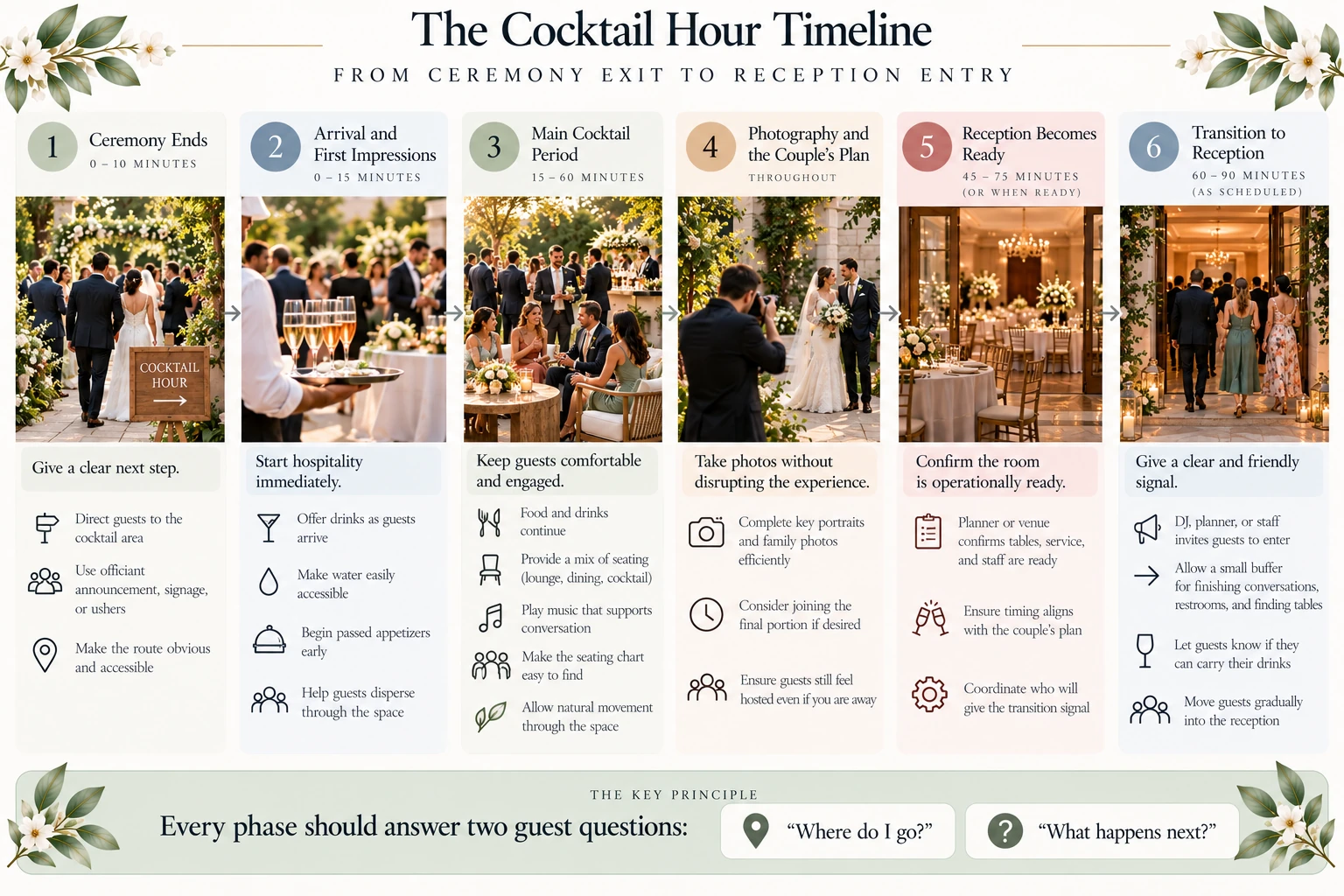
Before the wedding, review cocktail hour as a sequence rather than as a list of purchases.
Walk through:
Ceremony ends. What happens?
Then:
- Who directs guests?
- When does bar service begin?
- When does food begin?
- Where are musicians positioned?
- Where is the seating display?
- Where can guests sit?
- What happens in bad weather?
- Who tells guests the reception is open?
- When does the couple join?
- Who makes the final transition call?
This kind of operational walkthrough is more useful than simply confirming that you ordered enough cocktail tables.
A Simple Cocktail-Hour Plan Can Work Extremely Well
You do not need elaborate entertainment, multiple food stations, or a complex bar to create a successful cocktail hour.
A straightforward version might be:
Ceremony ends
Guests are guided to a nearby terrace.
First five minutes
Water and drinks are immediately available. Passed appetizers begin.
During the hour
Guests socialize with low-volume music. Several seating areas and cocktail tables are available. The seating chart is accessible throughout.
Final portion
The couple joins after photographs.
Transition
The DJ announces that the reception room is open. Guests already know their table assignments and move inside gradually.
That is enough.
The quality comes from the experience working smoothly, not from the number of features.
Common Cocktail-Hour Problems Are Usually Flow Problems
When cocktail hour feels unsuccessful, the problem is often not the decor.
Common issues include:
- guests do not know where to go;
- everyone reaches one bar simultaneously;
- food arrives too late;
- there is nowhere to sit;
- the space is too hot or too cold;
- the music is too loud for conversation;
- dietary options are unclear;
- the seating chart creates a queue;
- guests do not know when dinner begins;
- cocktail hour runs long because photographs or room setup are delayed.
These are operational issues.
Solve those first.
Flowers, signage design, custom napkins, and signature-drink names can improve the atmosphere, but they cannot compensate for hungry guests standing in a long line without knowing what happens next.
The Best Cocktail Hour Feels Like Part of the Wedding
Cocktail hour should not feel like an intermission between the “real” parts of the day.
It is a hosted experience in its own right.
Guests need surprisingly little when the fundamentals are right:
- a clear place to go;
- something to drink;
- enough food for the timing;
- somewhere to rest;
- music that supports conversation;
- comfortable movement through the space;
- a clear transition into the reception.
Start with those needs.
Then add the details that reflect your wedding.
If the service begins quickly, the space is comfortable, the layout avoids obvious bottlenecks, and guests always understand what comes next, cocktail hour can feel effortless—even when a great deal of planning happened behind the scenes.