

A guest cancelling shortly before your wedding can be disappointing.
A guest simply not appearing can feel even worse.
By that point, you may have finalized the seating chart, paid for catering, ordered stationery, confirmed transportation, and imagined that person being part of the day. It is understandable if your first reaction is frustration.
But late attendance changes are also one of those wedding situations where the practical problem and the personal feeling are best handled separately.
Your immediate job is to protect the event: update whatever can still be changed, tell the people who need to know, and avoid creating unnecessary disruption.
The relationship question can wait until later.
First, Distinguish a Cancellation From a No-Show
They are not quite the same situation.
A late cancellation means the guest tells you before the wedding that they can no longer attend.
A no-show means the guest had accepted the invitation but does not attend and either explains afterward or provides no explanation at all.
A cancellation—even a very late one—still gives you information you can potentially use.
A no-show usually gives you none.
That distinction matters practically, but it can also matter emotionally. Someone who contacts you as soon as circumstances change has handled the situation differently from someone who simply disappears.
Elegant digital invitations thoughtfully designed for a beautiful experience on every device.
Explore Templates
Not Every Late Cancellation Is Avoidable
People sometimes miss weddings for serious and unpredictable reasons.
Examples can include:
- illness;
- a sick child;
- a family emergency;
- travel disruption;
- pregnancy-related concerns;
- an accident;
- an unexpected caregiving responsibility;
- bereavement;
- another urgent personal situation.
You may never know every detail.
And guests should not have to prove that their reason is serious enough.
If someone tells you they cannot attend, the most useful initial response is usually simple:
Thank them for letting you know and deal with the logistics.
You can process the disappointment separately.
Do Not Ask for a Detailed Explanation in the Moment
When someone cancels, especially close to the wedding, it can be tempting to ask:
“What happened?”
Sometimes the guest will volunteer the reason.
If they do not, you generally do not need to interrogate them.
A short response such as:
“I’m sorry you won’t be able to make it. Thank you for letting us know.”
is usually enough.
If the person is a close friend or relative and you are genuinely concerned about them, you can naturally ask whether everything is okay.
The difference is important.
Concern is about the person.
Demanding justification is about determining whether their reason is acceptable.
The Timing of the Cancellation Determines What You Can Still Change
The closer you are to the wedding, the fewer practical adjustments may be possible.
A cancellation several weeks out may allow you to update almost everything.
A cancellation the morning of the wedding may change almost nothing financially.
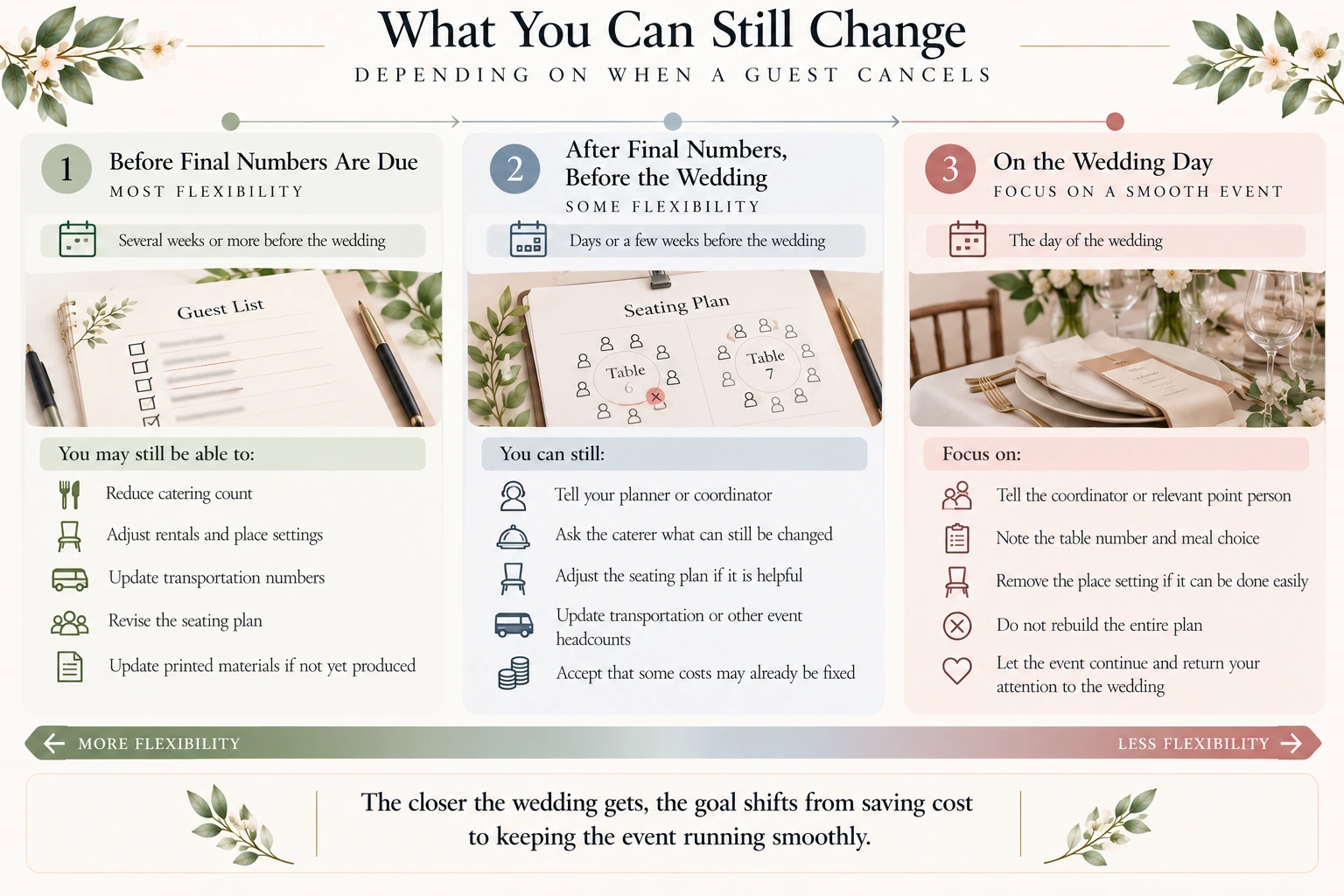
Think of cancellations in three practical windows:
Before final numbers are due
This is the easiest situation.
You may still be able to adjust:
- catering quantities;
- rental counts;
- place settings;
- transportation;
- printed seating materials;
- event headcounts.
After final numbers but before the wedding
Some vendors may still allow small changes, while others may not.
You can ask—but do not assume the cost will disappear.
On the wedding day
At this point, the practical goal is usually not saving money.
It is preventing confusion.
Tell the planner, venue coordinator, or relevant point person and let the event continue.
Contact the Right Vendor, Not Every Vendor
One guest cancelling does not usually require a complete vendor communication chain.
Think about which parts of the wedding are genuinely affected.
Possible contacts include:
- caterer;
- wedding planner or coordinator;
- venue;
- transportation provider;
- rental company;
- accommodation coordinator, if relevant.
If you have a planner or day-of coordinator, that person can often determine who actually needs the update.
Avoid creating more administrative work than the cancellation itself requires.
Ask Whether the Catering Count Can Still Be Adjusted
Catering is often the first financial concern after a late cancellation.
Contact the caterer or planner and ask:
- Has the final guarantee already been locked?
- Can the guest count still be reduced?
- Can the meal be reassigned?
- Does the change affect staffing or service?
- Is there anything useful that can be done with the extra meal?
The answer will depend on the specific agreement and timing.
Do not assume that because a guest is no longer attending, you automatically receive a refund.
By the time final numbers are confirmed, food, staffing, rentals, and production may already have been committed.
Do Not Let the Lost Meal Cost Dominate the Situation
It can be frustrating to realize that you paid for a meal that will not be used.
But once that money can no longer be recovered, repeatedly focusing on it usually does not improve anything.
You may think:
“They cost us $200 by cancelling.”
From your perspective, that feels real.
But the guest may have had an unavoidable emergency, and the catering commitment may have existed regardless of their reason.
Treat the financial issue as a planning consequence rather than a debt the guest now owes you.
A Guest Does Not Normally Owe You the Cost of Their Empty Seat
A wedding invitation is not a reservation contract between you and the guest.
Even when a late cancellation creates a financial loss, asking the person to reimburse the meal is generally not a graceful way to handle it.
The same applies to no-shows.
You can be disappointed by careless behavior without converting the relationship into an invoice.
There may be unusual private arrangements around travel or accommodation where someone explicitly agreed to reimburse a shared cost, but that is a separate issue from charging for a wedding seat.
Update the Seating Plan Only When It Helps
One cancellation does not always require rebuilding the entire reception layout.
If a table of eight becomes a table of seven and still works comfortably, leaving the arrangement alone may be easier.
If several guests cancel from the same table, however, the table may begin to feel visibly empty.
Then you might consider:
- moving a compatible guest or couple;
- combining tables if the venue and stationery still allow it;
- removing an unused place setting;
- adjusting table assignments before printing;
- letting the layout remain as planned if changes would create more disruption.
Do not chase perfect symmetry at the expense of stability.
Do Not Move Guests Casually Just to Fill Empty Seats
A last-minute empty chair can make couples want to “fix” the table.
But seating changes can create new problems.
Before moving someone, consider:
- who they were originally seated with;
- whether they know the new table;
- whether their partner is affected;
- whether place cards or meal indicators are already printed;
- whether the caterer uses seat positions;
- whether the move makes social sense.
An empty seat is not automatically worse than an uncomfortable seating change.
Remove the Place Setting If It Can Be Done Easily
If a guest cancels before guests enter the reception, removing the unused chair and place setting can make the table look intentional.
This is especially useful when the cancellation would otherwise leave:
- an obvious empty chair;
- a personalized place card;
- a menu with the guest’s name;
- a meal-selection marker.
Your coordinator, catering team, or venue staff can usually handle this quietly.
On the other hand, if changing the table would interrupt service or delay setup, leaving the seat alone is not a disaster.
Guests understand that plans change.
Tell the Planner or Coordinator About Same-Day Cancellations
Couples should not spend their wedding morning personally managing empty seats.
If someone messages you on the wedding day, pass the information to whoever is managing logistics.
That might be:
- your planner;
- coordinator;
- venue manager;
- caterer;
- a trusted designated family member.
A concise message is enough:
“Daniel Lee can no longer attend. He was at Table 8 and had the vegetarian meal.”
Then return to your wedding day.
Create a Simple Attendance Change Note
If several updates arrive in the final days, keep one short working list.
For example:
| Guest | Change | Table | Meal | Transport | Action |
|---|---|---|---|---|---|
| Daniel Lee | Cancelled | 8 | Vegetarian | Shuttle | Tell caterer + coordinator |
| Ava Thompson | Cancelled | 4 | Chicken | None | Remove place card |
| Marcus Hill | Attending, guest cancelled | 11 | Two meals → one | Hotel shuttle | Update count if possible |
The purpose is not to create another elaborate spreadsheet.
It is to prevent information from being scattered across texts, emails, and conversations.
Be Careful About Inviting Someone Else at the Last Minute
When a guest cancels, your first thought may be:
“Great—we can invite someone from the backup list.”
Sometimes that works.
Sometimes it creates more awkwardness than it solves.
Consider how much time remains.
If the wedding is still several weeks away, extending a late invitation may be reasonable if the person will not feel like an obvious replacement.
If the wedding is two days away, asking someone to fill an empty seat can feel very different.
Think about:
- travel requirements;
- accommodation;
- clothing;
- childcare;
- whether the guest already knows about the wedding;
- whether the relationship supports a spontaneous invitation.
Do not treat people as interchangeable bodies needed to fill paid chairs.
If You Use a Backup List, Use It Thoughtfully
Some couples maintain a second group of people they would genuinely like to invite if space becomes available.
That can work best when invitations are released early enough that the second guest still has a realistic opportunity to attend.
The key is that the person should be someone you actually want there.
A backup list should not become:
“Who can help us avoid wasting this meal?”
The emotional meaning of an invitation matters more than recovering a seat.
Do Not Publicly Complain About the Cancellation
A late cancellation may frustrate you, but broadcasting that frustration can make a manageable situation much worse.
Avoid posting things such as:
“People are cancelling three days before the wedding after we’ve already paid for them.”
Even without naming anyone, invited guests may know who cancelled.
The person may be dealing with circumstances you do not fully understand.
And public complaints can make other guests afraid to tell you when a legitimate emergency occurs.
Handle attendance changes privately.
What If Several Guests Cancel at Once?
Multiple cancellations can feel alarming, especially in the final week.
The first step is to separate emotional impact from operational impact.
Count the actual changes.
Then determine:
- how many meals are affected;
- whether tables need adjustment;
- whether transport numbers change;
- whether the venue layout still works;
- whether any printed materials need updating;
- whether you actually need to do anything.
A wedding planned for 120 guests does not suddenly become unsuccessful because 115 attend.
Guests experience the people who are present, not the percentage of invitees who ultimately arrived.
Illness Deserves Extra Flexibility
A guest who is ill should generally not feel pressured to attend because the wedding has already been paid for.
If someone tells you:
“I’m sick, but I know you’ve paid for my seat, so I’ll try to come anyway,”
you can make the expectation easier:
“Please take care of yourself—we completely understand if you need to stay home.”
A paid meal is not more important than someone’s health or the comfort of other guests.
The same principle can apply when a guest is caring for someone who becomes ill unexpectedly.
Travel Disruptions Are Often Outside the Guest’s Control
Destination weddings and weddings with significant travel can produce last-minute attendance changes because of:
- cancelled flights;
- major delays;
- missed connections;
- severe weather;
- transportation breakdowns.
If a guest genuinely tried to attend and circumstances prevented it, treat the problem as unfortunate rather than insulting.
If you have transportation or accommodation arrangements that can still be modified, update them.
Otherwise, there may be nothing to solve.
What If the Guest Cancels for a Reason That Feels Weak?
This is where etiquette becomes harder.
Perhaps someone cancels because:
- another social opportunity came up;
- they forgot about another commitment;
- they no longer feel like traveling;
- their explanation feels vague or careless.
You are allowed to feel hurt.
But the wedding week is rarely the best time to investigate or confront the person.
Respond briefly, update the logistics, and revisit the relationship later if it still matters to you.
A wedding does not need to become the courtroom where you decide whether every friend’s behavior was acceptable.
You Can Remember the Behavior Without Starting a Fight
Graceful handling does not require pretending that everything feels fine.
If a close friend cancels carelessly at the last minute, that may change how you see the relationship.
You can take note of that.
You can also choose to discuss it later.
The useful distinction is between:
not reacting impulsively during the wedding, and
never addressing a hurtful pattern at all.
Those are not the same thing.
What to Do When Someone Simply Does Not Show Up
A no-show can feel more personal because there was no warning.
But on the wedding day, the response should still be operational first.
Once you realize the person is absent:
- tell the coordinator if necessary;
- remove or ignore the unused place setting;
- let catering know if it affects service;
- do not delay the wedding;
- do not repeatedly check your phone;
- do not send an angry message during the reception.
There is almost nothing a confrontation can improve in that moment.
Continue with the celebration.
Do Not Call Missing Guests During the Reception Unless You Are Genuinely Concerned
If a close family member or friend is unexpectedly absent and you worry that something may have happened, checking on them can be appropriate.
But if your primary motivation is:
“Why aren’t you here?”
wait.
Your wedding reception is not the ideal time to chase guests for explanations.
If necessary, ask a trusted relative or friend to check privately.
Otherwise, follow up afterward.
Some Apparent No-Shows May Have a Simple Explanation
Before assuming disrespect, remember that communication can fail.
A guest may have:
- sent a message that did not reach you;
- told a family member who forgot to pass it on;
- contacted your partner instead;
- become ill suddenly;
- experienced an emergency while traveling;
- misunderstood the schedule;
- had a last-minute childcare problem.
None of these possibilities mean you must excuse every situation.
They simply mean it is sensible to know what happened before deciding what the absence means.
How to Follow Up After a No-Show
If the person does not contact you afterward, a neutral message can clarify the situation.
For someone you care about, you might write:
“We missed you at the wedding and wanted to make sure everything is okay.”
That gives them room to explain without beginning with an accusation.
Their response will often tell you much more than an angry message would.

If They Apologize, Decide What the Relationship Needs
Some situations require nothing more than:
“I’m sorry—we had an emergency.”
Others may involve a sincere apology for poor communication.
If you value the relationship, you do not necessarily need to turn one badly handled wedding absence into a permanent conflict.
At the same time, you are not required to dismiss behavior that genuinely hurt you.
The appropriate response depends on:
- how close you are;
- what happened;
- whether the behavior was avoidable;
- whether the person took responsibility;
- whether similar behavior is part of a pattern.
Etiquette can guide the conversation, but it cannot decide the relationship for you.
What If the Guest Never Mentions It?
A guest accepting an invitation, failing to attend, and never acknowledging it afterward can reasonably feel disrespectful.
If the relationship matters, address it directly rather than allowing silent resentment to grow.
Keep the conversation proportionate.
For example:
“We were surprised not to see you at the wedding and didn’t hear from you. I wanted to check what happened.”
You do not need to begin with the catering bill, the empty chair, or a list of wedding expenses.
Start with the missing communication.
That is usually the real etiquette issue.
Gifts Do Not Cancel Out a No-Show
A guest may send a wedding gift despite being unable to attend.
That is thoughtful, but it does not change the attendance issue.
Likewise, someone who no-shows without explanation has not automatically repaired the situation because a gift arrived.
Treat the two things separately:
- thank them for the gift;
- address the absence if the relationship warrants it.
Do not calculate whether the gift’s value compensates for the meal.
That turns both hospitality and gift-giving into transactions.
Do Not Expect a Guest to Send a Gift Because They Cancelled
A wedding gift is not a cancellation fee.
A guest who cannot attend may still choose to send something, especially if they are close to you.
But the cancellation itself does not create a new financial obligation.
Your response to the cancellation should not depend on whether a gift appears later.
Last-Minute Changes May Affect More Than Dinner
When a guest cancels, remember to check whether they were included in other operational plans.
Depending on the wedding, that might include:
- shuttle manifests;
- welcome-event headcounts;
- farewell brunch;
- reserved hotel arrangements;
- ceremony seating;
- escort cards;
- personalized favors;
- dietary notes;
- children’s meals;
- accessibility arrangements.
You do not need to change everything.
You simply want to avoid an obvious logistical mismatch.
Be Particularly Careful With Destination-Wedding Cancellations
Late cancellations can feel more complicated at destination weddings because more planning may be involved.
The couple or guest may have already paid for:
- hotel rooms;
- transfers;
- excursions;
- welcome events;
- multiple meals.
First determine who actually holds each reservation and what the cancellation terms are.
Do not assume every unused booking becomes the couple’s responsibility or the guest’s responsibility.
If there was a specific financial agreement between you, deal with that agreement separately and calmly.
Do not bundle it into a general argument about wedding etiquette.
Children Can Create Unpredictable Attendance Changes
Parents may need to cancel because:
- a child becomes ill;
- childcare falls through;
- travel becomes impractical;
- a family situation changes unexpectedly.
These cancellations can happen very late.
If children are not attending the wedding but childcare is essential for the parents’ attendance, understand that the two issues are connected.
You do not have to redesign your wedding’s child policy.
But flexibility and compassion about a last-minute family problem can preserve the relationship.
Your Wedding Party Is a Different Situation
A bridesmaid, groomsman, witness, reader, or another person with an active role creates both an attendance issue and a wedding-day responsibility issue.
If someone in the wedding party has to cancel:
- confirm that they are okay;
- identify which responsibilities genuinely need reassignment;
- tell the planner or officiant where relevant;
- change the processional or seating only as much as necessary;
- avoid trying to make every visual detail perfectly symmetrical.
The priority is keeping the ceremony and event functional.
A missing wedding-party member does not require rebuilding the entire day.
Vendors Do Not Need the Emotional Backstory
When communicating a cancellation to your caterer or coordinator, keep it operational.
They usually need to know:
- who is no longer attending;
- table number;
- meal choice;
- transport booking;
- any special arrangements tied to that guest.
They generally do not need to know why you think the guest’s excuse is unacceptable.
Keep vendor communication clean and useful.
Give Someone Else Authority to Handle Changes on the Wedding Day
One of the best protections against attendance stress is deciding in advance who handles last-minute updates.
That person could be:
- wedding planner;
- day-of coordinator;
- venue coordinator;
- trusted sibling;
- trusted friend.
Tell them what authority they have.
For example:
“If anyone cancels tomorrow, please update catering and the table setting as you think is best. You don’t need to ask us unless it affects the ceremony.”
That prevents small changes from repeatedly reaching the couple.
Avoid Counting Empty Chairs During the Wedding
Once the event begins, attendance management should end.
Do not spend dinner scanning tables and calculating who did not arrive.
You planned the wedding for the people you love.
Now the people who are actually present are the wedding.
A handful of empty chairs does not deserve more attention than a room full of guests who made the effort to celebrate with you.
A Calm Response Protects More Than Etiquette
How you handle late cancellations affects:
- your stress level;
- your relationship with the guest;
- your vendors;
- your wedding party;
- your partner’s experience;
- the tone of the final days.
A cancellation may genuinely be inconvenient.
A no-show may genuinely be hurtful.
Neither requires you to solve the emotional issue immediately.
The most useful order is:
Handle the logistics.
Have the wedding.
Understand what happened.
Then decide whether a conversation is needed.
A Practical Late-Cancellation Checklist
When a guest tells you they can no longer attend:
- Acknowledge the message kindly.
- Record the attendance change in one place.
- Tell your planner or coordinator.
- Ask the caterer whether the final count can still change.
- Update meal and dietary information.
- Check the seating plan.
- Update transport or additional-event numbers if necessary.
- Remove personalized materials if it is easy to do.
- Avoid unnecessary last-minute rearranging.
- Return your attention to the wedding.
For a no-show, begin around step three.
The conversation with the guest can happen afterward.
Grace Does Not Mean You Cannot Be Disappointed
Being gracious about a cancellation does not mean you must be happy about it.
You can appreciate that someone informed you and still wish they were coming.
You can accept an emergency and still feel sad.
You can also recognize when someone handled the situation poorly.
What matters is not allowing the first emotional reaction to create a larger problem during a week that already contains enough moving parts.
Late attendance changes are frustrating precisely because they occur when so many plans feel final.
But most of them do not need to become wedding crises.
Update what can still be changed. Accept what cannot. Let the professionals handle the operational details where possible.
And once the wedding begins, stop planning around the people who are absent.
Celebrate with the people who showed up.